

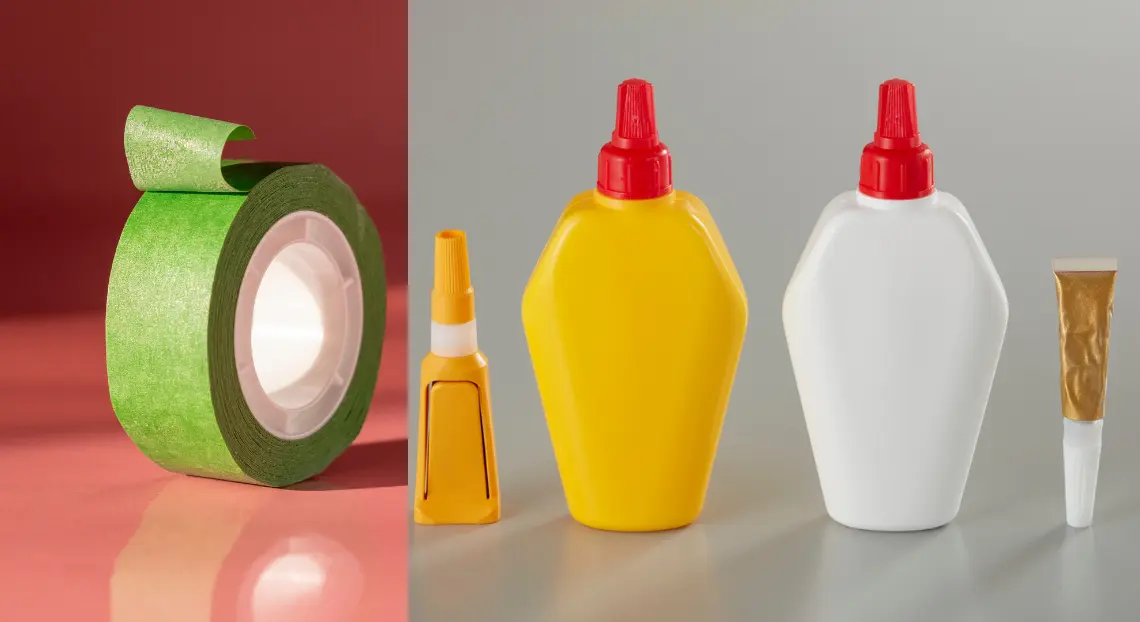
What Are Adhesives? Simple Definition
Adhesives are substances used to join two or more surfaces together. They are applied between materials to create a strong bond that holds them in place.
In simple terms, adhesives act like glue that sticks different materials such as paper, wood, metal, plastic, or fabric.
Adhesives help in bonding materials by forming a thin layer between the surfaces. This layer creates attraction and grip, which keeps the materials connected. Once applied, some adhesives dry quickly, while others take time to set and form a strong bond.
They are widely used because they can join materials without using nails, screws, or welding, making the process simple and efficient.
How Adhesives Work?
Adhesives work by creating a strong connection between surfaces at a very small level. This connection depends mainly on two forces called adhesion and cohesion, along with mechanical and chemical bonding.
Adhesion and Cohesion in Adhesives
Adhesion is the force that helps an adhesive stick to a surface. It happens when the molecules of the adhesive attract the molecules of another material. For example, glue sticking to wood or plastic is due to adhesion.
Cohesion is the force that holds the adhesive itself together. It keeps the adhesive layer strong and prevents it from breaking easily.
For a strong bond, both adhesion and cohesion must be balanced. If adhesion is weak, the glue will not stick properly. If cohesion is weak, the adhesive layer may break from inside.
Mechanical Bonding in Adhesives
Mechanical bonding happens when the adhesive flows into tiny holes and rough areas on the surface. Most surfaces are not completely smooth. They have small pores and gaps.
When the adhesive is applied in liquid form, it enters these small spaces. After drying or curing, it hardens and locks into these gaps. This creates a strong physical grip between the materials.
This type of bonding is common in wood, paper, and other rough materials.
Chemical Bonding in Adhesives
Chemical bonding happens at the molecular level. In this case, the adhesive forms actual chemical links with the surface of the material.
These bonds are very strong because they connect atoms and molecules directly. This type of bonding is often seen in adhesives like epoxy, which can bond metals and other hard materials.
In simple terms, adhesives work by sticking to surfaces, holding themselves together, and creating strong physical or chemical connections between materials.
Main Types of Adhesives
Adhesives are mainly divided into two types based on their source and composition. These are natural adhesives and synthetic adhesives. Each type has different properties, strength, and uses.
Natural Adhesives: Sources and Basic Uses
Natural adhesives are made from materials found in plants and animals. These include substances like starch, natural resins, and proteins such as casein or animal glue.
These adhesives have been used for a long time in simple applications. For example, starch-based glue is used in paper and packaging, while animal-based glue is used in woodwork and book binding.
Natural adhesives are easy to use and cost less. They are also safer for the environment because they come from renewable sources. However, they usually have lower strength and are less resistant to heat and moisture.
Because of these limits, they are mostly used for light work where strong bonding is not required.
Synthetic Adhesives: Materials and Common Examples
Synthetic adhesives are man-made and are created using chemicals, mainly polymers. These materials are designed to give better strength, durability, and resistance.
They are widely used in industries because they can be made for specific purposes and conditions. Synthetic adhesives can handle heat, water, and heavy load better than natural ones.
Common examples include epoxy, cyanoacrylate (super glue), and silicone. Epoxy forms a very strong and long-lasting bond, especially for metal and hard materials. Cyanoacrylate is a fast-acting adhesive that bonds quickly when exposed to moisture.
Silicone adhesives are flexible and can resist high temperatures, making them useful in construction and electronics.
In simple terms, natural adhesives are used for basic and light tasks, while synthetic adhesives are used where strong and durable bonding is needed.
Types of Adhesives Based on Use
Adhesives can also be classified based on how they are used and how they form a bond. Each type works in a different way and is suitable for different materials and conditions.
Water-Based Adhesives: Easy and Eco-Friendly Bonding
Water-based adhesives use water as a carrier to spread the adhesive on a surface. When applied, the water slowly evaporates, and a solid adhesive layer is left behind that bonds the materials together.
These adhesives are simple to use and safer because they do not contain strong chemicals. They work best on materials that can absorb water, such as paper, wood, and fabric. However, they may not perform well in high moisture conditions because water can weaken the bond.
Solvent-Based Adhesives: Strong and Durable Bonding
Solvent-based adhesives use chemical solvents to keep the adhesive in liquid form. After application, the solvent evaporates, leaving a strong and durable bond between the surfaces.
These adhesives are known for high strength and better resistance to heat and moisture. They can bond a wide range of materials, including metal, plastic, and rubber.
However, they may release strong fumes, so proper ventilation is important during use.
Hot Melt Adhesives: Fast Setting Adhesives
Hot melt adhesives are solid at room temperature and are heated before use. When heated, they melt into a liquid form and are applied to surfaces. As they cool down, they quickly turn solid again and form a bond.
These adhesives are widely used in packaging, furniture, and product assembly because they set very fast and do not require drying time.
Reactive Adhesives: High Strength Chemical Bonding
Reactive adhesives form a bond through a chemical reaction. This reaction starts when two components are mixed or when the adhesive is exposed to air, heat, or moisture.
They create very strong and long-lasting bonds and are used in demanding applications like construction, automotive, and electronics. These adhesives are ideal when high strength and durability are required.
In simple terms, each type of adhesive is designed for a specific purpose, depending on how fast it needs to set and how strong the bond should be.
Properties of Good Adhesives
A good adhesive must have the right properties to create a strong and long-lasting bond. These properties decide how well the adhesive performs under different conditions such as load, heat, and movement.
Strength and Durability of Adhesives
Strength is one of the most important properties. It shows how well an adhesive can hold materials together without breaking under pressure or load. Strong adhesives can handle pulling, pushing, and stress without failure.
Durability means how long the bond lasts over time. A durable adhesive can resist damage from moisture, chemicals, and environmental conditions. If durability is low, the bond may weaken or fail after some time.
For good performance, an adhesive must maintain both strength and durability in real working conditions.
Resistance to Heat and Water
A good adhesive should work well even when exposed to heat or moisture. Heat resistance means the adhesive can stay stable and keep its bonding strength at high temperatures.
Water resistance is also important, especially in outdoor or humid environments. Moisture can reduce bond strength if the adhesive is not designed to resist it. Adhesives used in construction, automotive, and electronics are often made to handle both heat and water.
Drying and Setting Time
Drying time refers to how quickly an adhesive sets and forms a bond. Some adhesives dry very fast, while others take more time to reach full strength.
Fast drying adhesives are useful for quick work and repairs. Slow drying adhesives are better when proper alignment and strong bonding are required. A good adhesive should have a suitable setting time based on its use.
Flexibility and Movement Handling
Flexibility is the ability of an adhesive to bend or stretch without breaking. This is important when bonded materials expand, contract, or move.
Flexible adhesives can absorb vibration and stress, which helps prevent cracks and bond failure. In applications where movement or temperature changes are common, flexibility improves the life of the bond.
Applications of Adhesives in Different Industries
Adhesives are used in many industries because they provide a simple and effective way to join materials. They help improve product quality, reduce weight, and make manufacturing easier.
Use of Adhesives in Packaging Industry
In the packaging industry, adhesives are widely used to seal boxes, cartons, labels, and flexible packaging. They help in fast production and secure packing of goods. Water-based and hot melt adhesives are commonly used because they set quickly and are cost-effective. Strong bonding ensures that packages remain closed during transport and storage.
Use of Adhesives in Construction Industry
Adhesives play an important role in construction work. They are used for fixing tiles, wood panels, flooring, insulation materials, and wall coverings. Adhesives provide a clean finish without the need for nails or screws. They also help in reducing noise and vibration in buildings. Many construction adhesives are designed to resist heat, water, and weather conditions.
Use of Adhesives in Automotive Industry
In the automotive industry, adhesives are used to bond metal, plastic, glass, and rubber parts. They are used in car interiors, windshields, panels, and electronic components. Adhesives help reduce the weight of vehicles by replacing mechanical fasteners. They also improve strength and help absorb vibration, which increases safety and comfort.
Use of Adhesives in Healthcare Industry
Adhesives are used in medical products such as bandages, tapes, and surgical dressings. They are designed to be safe for skin and easy to remove without causing damage. In some cases, special medical adhesives are used for wound closure instead of stitches. These adhesives must be clean, non-toxic, and reliable.
Use of Adhesives in Electronics Industry
In electronics, adhesives are used to assemble small and delicate parts. They help in bonding circuit boards, wires, and components. Adhesives also provide insulation and protect parts from heat and moisture. This improves the life and performance of electronic devices.
Use of Adhesives in Household Applications
Adhesives are commonly used at home for repairs and daily tasks. They are used to fix broken items, stick materials, and complete DIY projects. Products like glue, tape, and sealants make small repairs quick and easy without the need for tools.
In simple terms, adhesives are useful in almost every industry because they make bonding faster, cleaner, and more efficient.
Advantages of Using Adhesives
Adhesives offer many benefits compared to traditional joining methods like nails, screws, or welding. They make bonding easier, cleaner, and more efficient in many applications.
Strong Bonding and Better Load Distribution
One of the main advantages of adhesives is their strong bonding ability. They can create a firm connection between materials that can handle stress and pressure. In many cases, adhesive bonds can be as strong as or even stronger than mechanical joints.
Adhesives also spread the load evenly across the bonded surface. This reduces stress at a single point and helps prevent damage or failure.
This makes adhesives suitable for both light and heavy applications.
Lightweight Joining Method
Adhesives help reduce the overall weight of a product because they do not require extra parts like screws or bolts. This is very useful in industries like automotive and electronics, where weight reduction is important.
By removing metal fasteners, adhesives make the final product lighter without reducing strength.
Cost-Effective and Efficient Process
Using adhesives can reduce overall costs. They simplify the joining process by removing steps like drilling, welding, or fastening. This saves time, labor, and equipment costs.
Adhesives also support faster production, which increases efficiency in manufacturing.
Works on Different Materials
Adhesives can bond a wide range of materials, including metal, plastic, wood, glass, and fabric. They can even join different materials together, which is difficult with other methods.
This flexibility makes adhesives useful in many industries and applications.
In simple terms, adhesives provide strong bonding, reduce weight, lower costs, and work on many materials, making them a reliable and widely used solution.
Limitations of Adhesives
Adhesives are useful, but they also have some limits. These limits depend on the type of adhesive, the material used, and the working conditions. Understanding these limits helps in choosing the right adhesive for the job.
Not Suitable for All Materials
Adhesives do not work equally well on all surfaces. Some adhesives are designed only for specific materials like wood, paper, or plastic. Smooth and non-porous surfaces such as glass or certain metals may not bond properly with regular adhesives.
In many cases, the surface must be clean, dry, and properly prepared. Dust, oil, or roughness can reduce bonding strength.
Because of this, one type of adhesive cannot be used for every application.
Weak Performance in Heat and Moisture
Many adhesives are sensitive to heat and moisture. High temperature can soften the adhesive and reduce its strength. In some cases, the bond may fail completely when exposed to heat.
Moisture is another major problem. Water or humidity can weaken the bond, delay drying, or cause the adhesive to break down over time.
This makes some adhesives unsuitable for outdoor use or areas with high humidity.
Limited Lifespan and Ageing Issues
Adhesive bonds may not last forever. Over time, exposure to heat, sunlight, moisture, and chemicals can reduce their strength.
Adhesives also have a limited shelf life. Their properties can change during storage, which can affect their performance after use.
In some cases, the bond becomes weak or brittle, leading to failure.
Curing Time and Application Limits
Some adhesives need time to dry or cure before reaching full strength. This can slow down work, especially in fast production processes.
Also, incorrect application or poor surface preparation can lead to weak bonding.
In simple terms, adhesives are effective but must be used under the right conditions to get the best results.
Safety and Handling of Adhesives
Using adhesives safely is important because many adhesives contain chemicals that can affect health if not handled properly. Proper usage, storage, and precautions help reduce risks and ensure better performance.
Proper Use of Adhesives
Adhesives should always be used according to the instructions given by the manufacturer. It is important to read the label and Safety Data Sheet before use. These documents provide details about risks, handling, and safe usage.
Adhesives should be applied in a well-ventilated area to avoid breathing harmful vapours. Some adhesives release fumes that can affect the lungs and cause discomfort.
Direct contact with skin should be avoided, and spills should be cleaned immediately to prevent accidents or damage.
Using the correct amount of adhesive and proper tools also helps in safe and effective application.
Proper Storage of Adhesives
Adhesives must be stored in the right conditions to maintain their quality and safety. They should be kept in sealed containers and stored in a cool, dry place away from direct sunlight.
High temperature or moisture can damage adhesives and reduce their effectiveness.
Flammable adhesives should be stored away from heat, sparks, or open flames. Proper storage also helps in extending shelf life and preventing accidents.
It is also important to follow the recommended temperature range given by the manufacturer.
Health and Safety Precautions
Adhesives can cause health issues if safety steps are not followed. Some products may release toxic vapours or cause skin and eye irritation.
Wearing basic protective equipment like gloves, masks, and safety glasses helps reduce risk.
Avoid inhaling fumes and do not use adhesives in closed spaces without ventilation. Keeping adhesives away from food and drink areas is also important for safety.
In simple terms, safe handling of adhesives depends on proper use, correct storage, and basic safety precautions to protect both the user and the environment.
Conclusion
Adhesives play an important role in both daily life and industrial use. They provide a simple and effective way to join different materials without the need for nails, screws, or welding. From basic household repairs to advanced applications in construction, automotive, healthcare, and electronics, adhesives are widely used across many industries.
Understanding how adhesives work, their types, properties, and uses helps in choosing the right product for the right job. Each adhesive is designed for a specific purpose, and using the correct one ensures better strength, durability, and performance.
At the same time, it is important to know their limitations and follow proper safety and handling practices. This helps in avoiding risks and getting the best results.
In simple terms, adhesives are a reliable and versatile solution for bonding materials, making work easier, faster, and more efficient.
Frequently Asked Questions (FAQs) About Adhesives
What are adhesives used for?
Adhesives are used to join materials like wood, paper, plastic, metal, and glass in both household and industrial applications.
What is the difference between adhesive and glue?
Glue is a type of adhesive, usually used for light work. Adhesive is a broader term that includes all bonding substances, including strong industrial products.
How long do adhesives take to dry?
Drying time depends on the type. Some adhesives set in seconds, while others may take hours to fully cure.
Can adhesives be used on all materials?
No, not all adhesives work on every material. Each type is designed for specific surfaces and conditions.
Are adhesives waterproof?
Some adhesives are waterproof, but not all. It depends on the type and its formulation.
What makes an adhesive strong?
Good adhesion, strong internal bonding, and proper surface preparation make an adhesive strong.
Can adhesives replace screws or nails?
In many cases, yes. Adhesives can provide strong bonding without damaging the material, but it depends on the application.
Are adhesives safe to use?
Most adhesives are safe when used properly. It is important to follow instructions and use them in a well-ventilated area.
Do adhesives expire?
Yes, adhesives have a shelf life. Over time, they can lose their strength and effectiveness.
What is the best way to store adhesives?
Adhesives should be stored in a cool, dry place in tightly closed containers, away from heat and sunlight.