

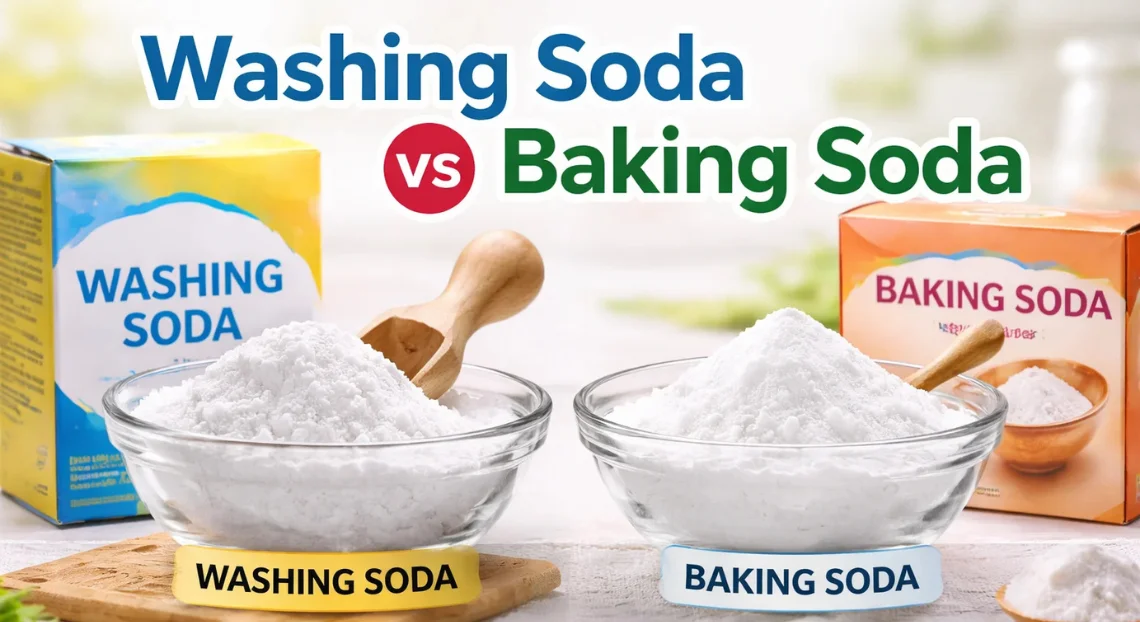
Introduction: Washing Soda vs Baking Soda
Washing soda and baking soda are two household powders that many people recognize, but not everyone knows how they differ. Both look similar — white and powdery — and both are used in cleaning, so it’s easy to assume they are the same. However, these two substances are chemically different and serve different purposes in the home.
Washing soda, also known as sodium carbonate, is a strong alkaline compound used mainly for tough cleaning jobs like heavy-duty laundry, removing grease, and softening hard water. Baking soda, on the other hand, is sodium bicarbonate — a milder alkaline powder used in baking, gentle cleaning, deodorizing, and even some personal care applications.
Why People Often Confuse Them?
The confusion between washing soda and baking soda comes partly because of their similar names and appearances. Both are white powders found in kitchens and laundry rooms, and both help with cleaning. Many people see them side by side on store shelves and assume they are interchangeable. In reality, they have different chemical compositions and strengths, which means they behave very differently when used.
When and Why This Comparison Matters?
Understanding the difference between washing soda and baking soda matters for both safety and effectiveness. Using washing soda in baking or personal care can be harmful because it’s too strong and not safe to eat. Likewise, using baking soda when a stronger cleaner like washing soda is needed might not get the job done, especially for tough grease and stains.
What You’ll Learn in This Article
In this article, you will learn:
- What washing soda and baking soda are
- How their chemistry differs
- Where each should and should not be used
- Safety tips and practical comparisons for real-life uses
By the end, you will clearly understand when to use each one and why they are not always interchangeable.
Definition of Washing Soda vs Baking Soda
Washing soda and baking soda may look similar, but they are defined by different chemical identities and purposes. Knowing their exact meaning helps avoid wrong usage at home or in cleaning.
What Is Washing Soda?
Washing soda is the common name for sodium carbonate. It is a strong alkaline compound mainly used for cleaning and industrial purposes. Washing soda is usually found as a white powder or crystals and is known for its ability to cut through grease, remove stains, and soften hard water.
Because of its high strength, washing soda is not safe for eating or personal care. It is designed strictly for laundry, household cleaning, and industrial use. Direct contact with skin can cause irritation, so careful handling is required.
What Is Baking Soda?
Baking soda is the common name for sodium bicarbonate. It is a mild alkaline compound that is safe for food use. Baking soda is widely used in cooking and baking as a leavening agent that helps food rise.
Apart from cooking, baking soda is also used for gentle cleaning, odor removal, and personal care tasks like toothpaste and deodorizing. Compared to washing soda, it is much less harsh and safer to handle.
Key Difference in Definition
The main difference lies in their strength and intended use:
- Washing soda is defined as a strong cleaner meant for tough tasks.
- Baking soda is defined as a food-safe, mild compound suitable for daily household use.
Even though their names sound similar, these two substances are chemically and practically different and should never be treated as the same product.
Chemical Name and Formula of Washing Soda vs Baking Soda
To clearly understand the difference between washing soda and baking soda, it is important to look at their chemical names and formulas. This basic chemistry explains why these two powders behave differently and are used for different purposes.
Chemical Name and Formula of Washing Soda
Washing soda is chemically known as sodium carbonate. Its chemical formula is Na₂CO₃.
This means one molecule of washing soda contains two sodium atoms, one carbon atom, and three oxygen atoms.
In most household products, washing soda is found in a hydrated form, which means it holds water molecules within its structure. This form is often written as Na₂CO₃·10H₂O. Because of this structure, washing soda is strongly alkaline. This high alkalinity makes it very effective for heavy cleaning, stain removal, and water softening, but also makes it unsafe for food use.
Chemical Name and Formula of Baking Soda
Baking soda is chemically called sodium bicarbonate. Its chemical formula is NaHCO₃.
Each molecule contains one sodium atom, one hydrogen atom, one carbon atom, and three oxygen atoms.
The presence of hydrogen makes baking soda less alkaline than washing soda. This mild nature allows baking soda to be safe for cooking and baking. When heated or mixed with acids, it releases carbon dioxide, which helps food rise.
Common Household Names: Washing Soda vs Baking Soda
Many people know washing soda and baking soda by their simple common names, but these names can vary based on region and context. Let’s look clearly at how each is commonly called.
Common Names for Washing Soda
Washing soda is best known by this common name in everyday use. It refers to the chemical sodium carbonate, especially when it is used for cleaning and laundry.
1) Washing soda is the most widely used common name.
2) You might also see it labelled as soda ash or soda crystals on product packaging. These names are especially common in cleaning and industrial products.
In simple terms, whenever you see a product called washing soda, soda ash, or soda crystals, it almost always means sodium carbonate, which is a strong cleaning compound.
Common Names for Baking Soda
Baking soda has several friendly names that people use, especially in kitchens and homes. The most common ones are:
1) Baking soda (the most widely known name)
2) Bread soda or cooking soda in some regions
3) Bicarbonate of soda or simply bicarbonate in places like the UK and Australia
All these names refer to the same chemical compound — sodium bicarbonate. Baking soda is mild in strength and safe to use in food, cleaning, and even personal care.
Chemical Composition Comparison: Washing Soda vs Baking Soda
Understanding the chemical composition of washing soda and baking soda explains why they behave so differently. Even though both are white powders and both contain sodium, their formulas and structures are not the same.
Chemical Formula Difference
1) Washing soda has the chemical formula Na₂CO₃. This means it has two sodium (Na) atoms, one carbon (C) atom, and three oxygen (O) atoms.
2) Baking soda has the formula NaHCO₃. This contains one sodium (Na), one hydrogen (H), one carbon (C), and three oxygen (O) atoms.
The extra hydrogen atom in baking soda is a key difference.
Molecular Structure
In washing soda, the carbonate part is made of one carbon atom bonded to three oxygen atoms and paired with two sodium atoms. In baking soda, the bicarbonate part has a similar setup but with an additional hydrogen attached. This small change affects how each compound reacts chemically.
Carbonate vs Bicarbonate
The main structural difference:
1) Carbonate (CO₃²⁻) is found in washing soda and makes it more alkaline and stronger.
2) Bicarbonate (HCO₃⁻) is found in baking soda and makes it milder in reaction.
Why Structure Matters in Usage
The chemical structure directly affects how each substance works:
1) Washing soda’s stronger alkaline nature makes it better for heavy cleaning, grease removal, and water softening.
2) Baking soda’s mild structure makes it ideal for baking, deodorizing, and gentle household tasks.
This difference in chemical makeup explains why washing soda is not safe for food and baking soda should not replace washing soda in tough cleaning jobs. Understanding these basics helps you choose the right product for the right use.
pH Level Comparison: Washing Soda vs Baking Soda
The pH level tells you how acidic or alkaline (basic) a substance is on a scale from 0 to 14. A pH of 7 is neutral (like pure water). Values above 7 are alkaline, and the higher the number, the stronger the alkalinity. Both washing soda and baking soda are alkaline, but their pH levels are quite different, which affects how they are used.
pH of Washing Soda
Washing soda is much more alkaline. When dissolved in water, its pH usually falls around 11 to 12. This strong alkalinity makes washing soda a powerful cleaner that can break down grease, oils, and tough stains more easily than gentler substances. However, because of this high pH, washing soda can also be harsh on skin, eyes, and some surfaces, so it should be handled with care and often requires gloves during use.
pH of Baking Soda
Baking soda has a much lower pH, generally around 8 to 9 in water. This places it in the mildly alkaline range. Because its alkalinity is gentle, baking soda is safe enough for baking and food use, as well as for light cleaning and deodorizing tasks. Its lower pH makes it less powerful at breaking down heavy grease or mineral buildup compared with washing soda, but also less irritating and safer for everyday tasks.
Why pH Matters in Real Use
1) Stronger pH (washing soda): Better for heavy-duty cleaning, laundry boosts, and hard water softening.
2) Milder pH (baking soda): Better for baking, deodorizing, gentle surface cleaning, and personal care.
In simple terms, washing soda’s higher pH makes it a stronger cleaning agent, while baking soda’s lower pH makes it safer for food use and mild tasks. This pH difference is one of the main reasons these two powders are used very differently in everyday life.
Which Is More Alkaline and Why: Washing Soda vs Baking Soda
When we talk about alkalinity, we mean how basic a substance is on the pH scale. Both washing soda and baking soda are alkaline, but washing soda is much more alkaline than baking soda. This difference comes from the way each chemical is built and how they react in water.
Washing soda
Washing soda (sodium carbonate) has a higher pH value, usually around 11–12 when dissolved in water. This high pH means it has stronger alkaline properties, which helps it break down tough stains, grease, and mineral buildup. The absence of hydrogen in its chemical makeup (Na₂CO₃) allows washing soda to release more hydroxide ions (OH⁻) in water, increasing its basic strength. This strong alkalinity makes washing soda very effective for heavy-duty cleaning but also more reactive and potentially irritating.
Baking soda
Baking soda (sodium bicarbonate), on the other hand, has a lower pH, usually around 8–9 in water. Its chemical structure (NaHCO₃) includes a hydrogen atom, which makes it less alkaline and much milder. Because of this, baking soda is safe for use in baking, deodorizing, and light cleaning tasks where high strength is not needed.
Impact of Alkalinity on Cleaning, Health, and Safety
- Cleaning: Washing soda’s stronger alkalinity makes it better for tough jobs like deep cleaning laundry or stubborn grease. Baking soda works well for gentle cleaning, mild stains, and deodorizing.
- Health: High alkalinity (washing soda) can cause skin irritation, eye discomfort, or throat irritation if inhaled or ingested accidentally. Baking soda’s mild alkalinity is generally safe for food use and skin contact in normal quantities.
- Safety: Washing soda should be handled with care — gloves and masks are often recommended. Baking soda is safe for most household tasks and is even used in cooking.
In simple terms, washing soda’s higher alkalinity makes it a strong cleaner, while baking soda’s lower alkalinity makes it a safe and gentle everyday product.
Physical Properties Comparison: Washing Soda vs Baking Soda
Understanding the physical properties of washing soda and baking soda helps you see why they look and feel different, and why they are used in different ways around the home.
Appearance and Texture
Washing soda usually appears as a white or off-white crystalline powder or granules. Its crystals can be larger and more coarse in texture, especially when in the decahydrate form (with water molecules bound to it). This gives washing soda a more grainy and solid feel.
Baking soda, on the other hand, looks like a fine, soft white powder. It has a smooth and flour-like texture that dissolves easily in water. The fine texture is one reason baking soda is popular for cooking and gentle cleaning.
Solubility and Density
Both powders can dissolve in water, but washing soda is more soluble and dissolves faster, forming a strongly alkaline solution. Its density is also slightly higher than baking soda, meaning it feels a bit heavier per volume.
Other Physical Traits
1) Color: Both washing soda and baking soda are generally white and odorless.
2) Crystalline Form: Washing soda may show visible crystals because of its water of crystallization. Baking soda usually stays powdery without visible crystals.
3) Feel: Washing soda can feel slightly rougher or grainy, while baking soda feels soft and powdery.
Why These Differences Matter
The physical differences affect how each is used:
1) Washing soda’s coarse, granular form and strong dissolution make it better for scrubbing and heavy cleaning.
2) Baking soda’s fine, soft powder makes it safer and easier to use in baking, deodorizing, and gentle cleaning.
Knowing these physical traits helps you choose the right product for cleaning, cooking, or other uses around the house without confusion.
Household Cleaning Uses of Washing Soda vs Baking Soda
Washing soda and baking soda are both used in household cleaning, but they are meant for different cleaning strengths and purposes. Understanding how each one works helps you choose the right option for safe and effective cleaning.
Household Cleaning Uses of Washing Soda
Washing soda is mainly used for strong and heavy cleaning tasks. Its high alkalinity allows it to break down grease, oil, and stubborn dirt that regular cleaners cannot remove easily. It is commonly used in laundry to boost detergent performance, remove tough stains, and soften hard water. In kitchens and bathrooms, washing soda helps clean greasy surfaces, soap scum, and mineral deposits. Because it is powerful, washing soda works best on hard surfaces and areas that require deep cleaning. However, it can irritate the skin and damage delicate materials, so careful handling is important.
Household Cleaning Uses of Baking Soda
Baking soda is used for mild and everyday household cleaning. It is gentle enough for frequent use and safe on most surfaces. Baking soda is commonly used to clean kitchen counters, sinks, and stovetops without scratching. It is also well known for removing bad odors from refrigerators, carpets, shoes, and trash bins. Its mild nature makes it suitable for light stain removal and gentle scrubbing. Because baking soda is safe and non-harsh, it is often preferred for cleaning areas that come into contact with food.
Which Works Better for What
Washing soda works better for deep cleaning and heavy dirt, especially where grease, stains, or hard water buildup are present. Baking soda works better for daily cleaning and deodorizing, where safety and surface care are more important than strength. In simple terms, washing soda is best when strong cleaning action is needed, while baking soda is the better choice for gentle and safe household cleaning.
Laundry Uses of Washing Soda vs Baking Soda
Laundry is one of the most common areas where both washing soda and baking soda are used. While both can help improve washing results, they serve different purposes and act in different ways.
How Each Works in Laundry
Washing soda works as a strong laundry booster. It increases the cleaning power of your detergent by raising the water’s alkalinity. This helps break down tough dirt, grease, and stains more effectively than detergent alone. Washing soda also helps to combat hard water, allowing soap and detergent to work better.
Baking soda, on the other hand, works more gently. It helps to balance the pH of laundry water, making detergents more effective at lower temperatures. It also helps to neutralize odors in fabrics, keeping clothes smelling fresh without the need for strong chemicals.
Stain Removal Effectiveness
When it comes to stain removal, washing soda is generally more effective for stubborn, set-in stains like oil, mud, or grease. Its strong alkaline nature breaks down heavy soil faster than baking soda.
Baking soda is better suited for light stains or fresh spills. It can help lift and lighten marks on clothes, especially when used as a pre-soak or mixed into detergent, but it is not as powerful as washing soda on deep, difficult stains.
Water Softening Properties
Washing soda is well known for its ability to soften hard water. Hard water contains minerals like calcium and magnesium that make cleaning harder. Washing soda binds these minerals, allowing detergent to work more effectively.
Baking soda can help a little with water softening, but its effect is much weaker compared with washing soda. Its main benefit in laundry is odor control, not water treatment.
Impact on Fabric and Colors
Washing soda’s strong chemical nature means it may be too harsh for delicate fabrics like silk, wool, or bright colors. It can cause fading or weakening of fibers if used too often or in high amounts. For these items, baking soda is a safer, gentler choice because it helps freshen and brighten without harsh action.
In simple terms, washing soda is ideal when you need strong cleaning and stain removal, while baking soda is best for everyday laundry freshness, mild cleaning, and odor control. Use each product according to the needs of your wash load to get the best results.
Industrial and Commercial Uses of Washing Soda vs Baking Soda
Washing soda and baking soda are both useful beyond the home. They play key roles in industry and commercial production. Their different chemical strengths make them suited to different large-scale tasks.
Industrial Uses of Washing Soda
Washing soda (sodium carbonate) is widely used in heavy industries because of its high alkalinity. One of its largest uses is in glass manufacturing. Sodium carbonate helps lower the melting point of silica, making it easier to form glass. This makes production faster and uses less energy.
Another major use of washing soda is in soap and detergent production. It works as a raw material that helps combine fats and oils with alkali. This chemical reaction is essential in making many cleaning products. Without washing soda, many soaps and detergents would be less effective.
Washing soda is also vital in water treatment. It is used to soften hard water by removing calcium and magnesium ions. This allows industrial boilers and cooling systems to run more efficiently and reduces scale buildup. Water treatment plants also use washing soda to help balance pH levels and make water safer for various uses.
Commercial Uses of Baking Soda
Baking soda (sodium bicarbonate) has many commercial uses, especially where a mild and safe reaction is needed. One of its best-known roles is in the food industry. It is used as a leavening agent in baking, helping dough and batter rise by releasing carbon dioxide gas when heated.
In the pharmaceuticals industry, baking soda is used in medicines to help reduce stomach acid and relieve heartburn. It is also used in toothpaste and other personal care products because it gently cleans without harsh chemicals.
Another important commercial use of baking soda is in fire extinguishers. When heated in a fire extinguisher, baking soda releases carbon dioxide, which helps smother flames. This makes it useful for small kitchen fires and some types of portable fire extinguishers.
In simple terms, washing soda is favored in heavy industrial processes where strong alkaline action is needed, while baking soda is preferred in food, health, and safety applications because it is milder and safer for people to use.
Safety and Handling Comparison: Washing Soda vs Baking Soda
Safety and proper handling are important when using washing soda or baking soda at home or in larger tasks. Understanding the risks and precautions helps protect your health and prevents damage to surfaces.
Is Washing Soda Safe to Touch?
Washing soda is not very safe to touch directly with bare hands. It is a strong alkaline substance with a high pH level. If washing soda comes into contact with the skin, it can cause irritation, redness, or even mild burns in some cases. It may also irritate the eyes if accidentally rubbed into them. Always handle washing soda with care, and avoid direct contact whenever possible.
Is Baking Soda Safe for Skin and Ingestion?
Baking soda is generally safe for skin contact and limited ingestion. It is mild in nature and is even used in personal care products like toothpaste, deodorants, and bath soaks. Baking soda is also safe to use in food and baking in the correct amounts. However, swallowing baking soda in large amounts or inhaling its dust should still be avoided, as it can cause stomach discomfort or coughing.
Precautions to Take When Handling
When using washing soda, it is important to wear protective gloves to shield your skin. If you are working with large quantities or in a powdered form that can spread in the air, consider wearing a face mask and eye protection. Avoid creating dust clouds and keep the powder away from your eyes and mouth.
With baking soda, everyday use usually does not require special protection. Simply avoid inhaling the powder and keep it out of reach of young children who might eat it in large amounts.
Storage Guidelines for Both Substances
Both washing soda and baking soda should be stored in closed, dry containers to prevent them from absorbing moisture. Keep them in a cool and dry place, away from direct sunlight and heat. Washing soda should be kept out of reach of children and pets due to its stronger chemical nature. Baking soda, while safer, should also be stored properly to maintain its effectiveness and avoid contamination.
In simple terms, washing soda needs more careful handling and protection, while baking soda is safer and gentler for common household use. Always follow directions on product labels and keep both substances stored properly for safety.
Health Effects and Toxicity: Washing Soda vs Baking Soda
Understanding the health effects and toxicity of washing soda and baking soda is important for safe use at home. These two substances have very different effects on the body because of their chemical strength.
Health Risks of Washing Soda
Washing soda (sodium carbonate) is a strong alkaline substance. It can irritate or burn the skin, eyes, and respiratory system if not handled carefully. Direct contact with washing soda can cause redness, itching, or a burning feeling on the skin. If dust from washing soda is inhaled, it may irritate the nose and throat, leading to coughing or discomfort.
Washing soda is not safe to eat. It can cause serious irritation to the mouth, throat, and stomach if swallowed. For these reasons, washing soda should always be kept away from children and pets and used with proper precautions like gloves and eye protection.
Baking Soda Health Considerations
Baking soda (sodium bicarbonate) is much milder and is widely used in food, health, and personal care. In small amounts, baking soda is safe to eat and is used in baking and cooking to help dough rise. It is also sometimes used to relieve heartburn or indigestion, but only in small, controlled amounts.
However, consuming large amounts of baking soda can upset the stomach and lead to gas, bloating, or nausea. People with certain health conditions should avoid taking baking soda internally unless advised by a doctor.
What Happens if Ingested Accidentally
If washing soda is swallowed, it can cause severe irritation, vomiting, and stomach pain. Immediate medical help should be sought. Washing soda ingestion can be dangerous because of its high alkalinity.
If baking soda is accidentally eaten in small amounts, it usually causes mild discomfort at most. In larger amounts, it may upset digestion, and medical advice should be considered if symptoms are strong.
First-Aid Basics
For washing soda exposure on the skin, wash the area thoroughly with water and remove contaminated clothing. If washing soda gets into the eyes, rinse with clean water for several minutes and seek medical help. If swallowed, contact poison control or a doctor immediately.
For baking soda, rinse the mouth with water if too much is eaten, and drink water to help dilute it. Seek medical advice if symptoms persist.
In short, washing soda has higher health risks and should be handled carefully, while baking soda is safer in everyday use, though large amounts can still cause discomfort.
Environmental Impact Comparison: Washing Soda vs Baking Soda
Understanding how washing soda and baking soda affect the environment helps you choose better cleaning and household products. Although both are commonly used, their effects on water, soil, and ecosystems can differ.
Biodegradability
Baking soda is a naturally occurring compound that breaks down into harmless substances when disposed of properly. It dissolves in water and becomes simple ions like sodium and carbon dioxide, which do not leave harmful residues behind. This makes baking soda biodegradable and gentle on the environment when used in normal household amounts.
Washing soda is an inorganic salt that does not technically “biodegrade” like organic materials. However, because it dissolves easily in water and does not build up in soil or organisms, it does not persist in the environment the same way some chemicals do. At typical household concentrations, washing soda is considered low risk compared with many synthetic cleaning agents.
Effect on Water Systems
When either substance enters water bodies in large amounts, it can raise the water’s pH (make it more alkaline). High alkalinity can be harmful to fish and other aquatic life that need a specific pH range to survive. Washing soda, with its higher alkalinity, can cause greater pH shifts than baking soda if released in large quantities. Baking soda’s impact on water is much gentler because it buffers pH gradually and does not create abrupt chemical changes.
Eco-Friendliness Comparison
Both washing soda and baking soda are considered more environmentally friendly than many commercial cleaners that contain phosphates, chlorine, or harsh solvents. These traditional chemicals can cause long-lasting harm in soil and water. In comparison, washing soda and baking soda pose minimal direct risk when used responsibly.
Which Is Safer for Regular Household Use
For everyday home use, baking soda is generally the safer and more eco-friendly option. It dissolves easily, breaks down into natural elements, and does not dramatically change water pH levels. Washing soda is still acceptable for cleaning but should be used in moderation and disposed of with care to avoid large-scale environmental impact.
In simple terms, both are low-impact choices compared with harsh chemical cleaners, but baking soda is kinder to water systems and ecosystems when used regularly in households.
Cost and Availability Comparison: Washing Soda vs Baking Soda
Understanding how much washing soda and baking soda cost and where you can buy them helps you choose the right product without overspending. Below is a clear comparison of market availability, pricing, and which option is more economical for home use, including the India context.
Market Availability
Both baking soda and washing soda are widely available in supermarkets, chemical stores, and online marketplaces.
In India, you can find baking soda from many brands such as Tata I-Shakti, Weikfield, Kwality, ANNPRASH, and Goshudh, sold in grocery stores and online platforms like Amazon and Flipkart.
Washing soda (sodium carbonate) is also available in supermarkets, cleaning product aisles, and chemical supply stores. It may sometimes be labeled as soda ash or washing powder in local shops.
Typical Pricing
The cost of these products varies with pack size, brand, and purchase location:
- Weikfield Baking Soda Jar and similar small packs of baking soda often cost a low amount per 100-g jar, making them easy to buy for kitchen and cleaning needs. Baking soda prices in India generally range from about ₹30 to ₹100 per kg depending on brand and shop.
- VITSZEE washing soda powder 400gm and other washing soda products typically cost around ₹20 to ₹100 per kg locally, often depending on purity and packaging.
Overall, washing soda often comes at a slightly lower price per kilogram when bought in bulk bags from local chemical stores.
Which Is More Economical for Home Use
For everyday household use, both baking soda and washing soda are affordable. However, if you need a lot of product for cleaning or laundry, washing soda can be more economical per unit weight, especially when bought in larger packs from chemical suppliers. Baking soda is slightly more expensive per kilogram when sold in retail food-grade packaging.
Availability in India
In India, both products are easy to find in city supermarkets and online shops. Baking soda is common in grocery and baking sections, while washing soda may be found in cleaning or chemical sections of stores or e-commerce listings. Brands of both are available across major platforms.
In summary, both washing soda and baking soda are affordable and widely available. Washing soda is often cheaper per kilogram and easier to find in bulk, while baking soda is also inexpensive and easy to buy in food-grade and household packs.
Common Myths and Misconceptions: Washing Soda vs Baking Soda
There are many misunderstandings about washing soda and baking soda. Because both are white powders and used for cleaning, people often think they are the same. Below are the most common myths explained in a simple and clear way.
Myth 1: Washing Soda and Baking Soda Are the Same
This is the most common misconception. Washing soda and baking soda are not the same chemical. Baking soda is sodium bicarbonate, while washing soda is sodium carbonate. Washing soda is much stronger and more alkaline. Because of this difference, they cannot always be used in the same way.
Myth 2: They Can Be Used Interchangeably in All Cleaning Tasks
Many people believe one can replace the other in any cleaning job. This is not true. Washing soda is better for heavy cleaning, grease removal, and laundry boosting. Baking soda is better for mild cleaning, deodorizing, and surfaces that need gentle care. Using washing soda where baking soda is needed can damage surfaces or cause skin irritation.
Myth 3: Both Are Safe to Eat
Only baking soda is safe to consume in small amounts and is used in cooking and baking. Washing soda is not food-grade and should never be eaten. Swallowing washing soda can cause serious health problems.
Myth 4: Washing Soda Is Just Strong Baking Soda
Some people think washing soda is simply baking soda in a stronger form. While baking soda can be converted into washing soda by heating, once converted, it becomes a different substance with different uses and safety rules. This difference is important for health and cleaning safety.
Myth 5: Baking Soda Is Too Weak to Be Useful
Baking soda may be mild, but it is still very effective for odor control, light stains, and gentle cleaning. Its lower strength makes it safer for regular household use, especially around food areas.
Myth 6: Both Are Harmful to the Environment
Compared to many chemical cleaners, both washing soda and baking soda are more eco-friendly when used correctly. Baking soda is gentler on water systems, while washing soda should be used carefully to avoid excess alkalinity.
Understanding these myths helps you choose the right product for the right purpose, avoid damage, and use both substances safely and effectively.
Effect on Surfaces and Materials: Washing Soda vs Baking Soda
Before using washing soda or baking soda for cleaning, it is important to know how they affect different surfaces. Their strength level plays a big role in whether a surface stays safe or gets damaged.
Effect on Metals
Washing soda is highly alkaline and can react with some metals. It may cause corrosion or dullness on aluminum, brass, and copper if used often or left for too long. It is generally safe on stainless steel when diluted and rinsed properly.
Baking soda is much gentler and usually safe for most metals. It is often used to clean stainless steel, silver, and cookware without causing damage when used lightly.
Effect on Tiles
Washing soda works well on ceramic and porcelain tiles, especially for removing grease and deep stains. However, it should not be used on natural stone tiles like marble or granite, as it can damage the surface.
Baking soda is safe for most tiles, including natural stone, when used gently. It cleans without affecting the tile finish.
Effect on Plastic
Washing soda can weaken or discolor some plastic surfaces, especially thin or low-quality plastic. Long exposure should be avoided.
Baking soda is safe for plastic containers, kitchen items, and bathroom accessories. It is often used to remove odors and light stains from plastic.
Effect on Wood
Washing soda is not recommended for wood surfaces. It can remove natural oils, cause dryness, and damage wood polish or finish.
Baking soda should also be used carefully on wood. Light cleaning may be safe, but scrubbing can scratch the surface or remove polish.
Risk of Corrosion or Damage
Because washing soda is stronger, it carries a higher risk of surface damage if used incorrectly. Baking soda has a much lower risk and is safer for delicate materials.
Safe vs Unsafe Surfaces
Washing soda is best for hard, non-delicate surfaces like ceramic tiles and heavy-duty cleaning areas. Baking soda is safer for most household surfaces, especially where gentle cleaning is needed.
In simple terms, baking soda is safer for regular use, while washing soda should be used carefully and only where strong cleaning is required.
Conclusion:
Washing soda and baking soda may look similar, but they are very different in strength, safety, and use. Washing soda is a strong alkaline compound mainly used for heavy cleaning, laundry boosting, and industrial purposes. It works well on tough grease, stains, and hard water problems, but it must be handled carefully because it can irritate skin, damage surfaces, and is not safe to eat.
Baking soda, on the other hand, is much milder and safer for everyday use. It is commonly used in cooking, gentle cleaning, deodorizing, and personal care. Its lower alkalinity makes it suitable for many household surfaces, and it is safe to use around food when used in small amounts.
When choosing between washing soda and baking soda, the key is to match the product to the task. Use washing soda when you need strong cleaning power and are working on durable surfaces. Choose baking soda for regular home cleaning, odor control, and situations where safety matters more than strength.
Understanding the differences helps you avoid damage, protect your health, and clean more effectively. By using each product in the right way, you can get better results while keeping your home safe and well maintained.
FAQs
1. Are washing soda and baking soda the same thing?
No. Washing soda and baking soda are different chemicals. Washing soda is sodium carbonate, and baking soda is sodium bicarbonate. Washing soda is much stronger.
2. Can I use washing soda instead of baking soda for cleaning?
Only for heavy cleaning. Washing soda works well for tough stains and grease, but it is too strong for delicate surfaces where baking soda is safer.
3. Is baking soda safe to eat but washing soda is not?
Yes. Baking soda is food-grade and safe in small amounts. Washing soda is not edible and should never be eaten.
4. Which is better for laundry: washing soda or baking soda?
Washing soda is better for removing heavy stains and softening hard water. Baking soda helps with odor removal and gentle cleaning.
5. Can washing soda damage surfaces?
Yes. Washing soda can damage aluminum, wood, natural stone, and delicate surfaces if used incorrectly. Always use it carefully.
6. Is baking soda strong enough for household cleaning?
Yes. Baking soda works well for everyday cleaning, deodorizing, and light stains, even though it is milder than washing soda.
7. Can I mix washing soda and baking soda together?
It is usually not needed. Each has a different purpose, and mixing them does not give extra benefits for most household tasks.
8. Which is more eco-friendly: washing soda or baking soda?
Baking soda is more eco-friendly for regular use because it is gentler on water systems. Washing soda should be used in limited amounts.
9. Is washing soda safe for skin?
No. Washing soda can irritate or burn the skin. Gloves are recommended when handling it. Baking soda is much safer for skin contact.
10. Which one should I keep at home: washing soda or baking soda?
For most homes, baking soda is enough for daily use. Washing soda is useful if you often deal with heavy cleaning or hard water problems.