
What is Acrylamide?
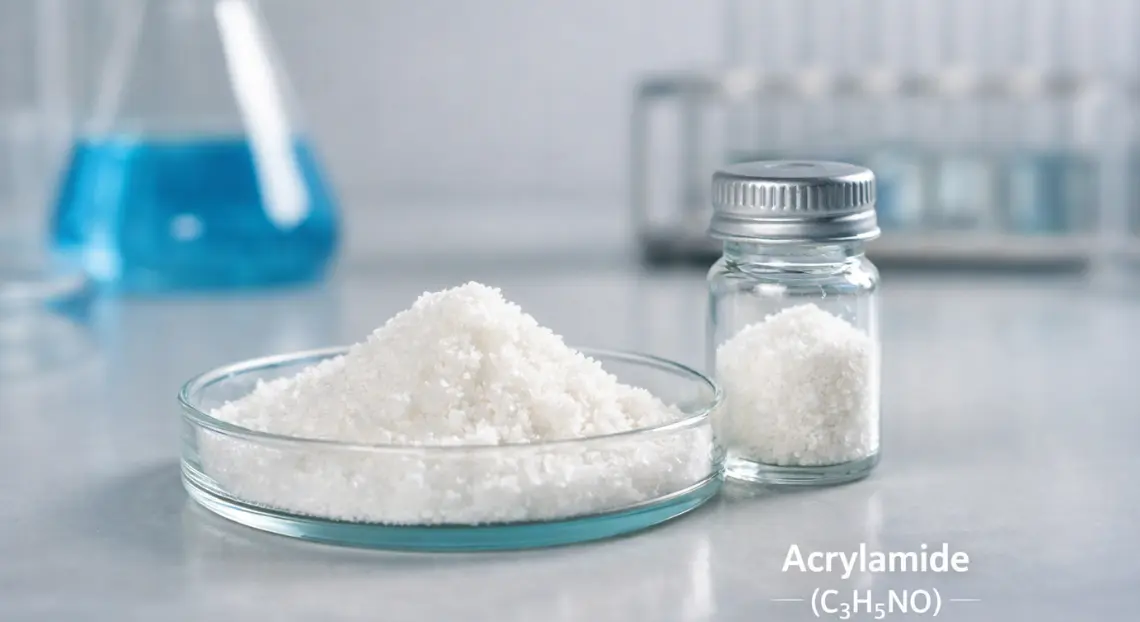
Acrylamide is an organic chemical compound used mainly in the production of polymers. It is a white, odorless crystalline solid that dissolves easily in water.
The chemical formula of acrylamide is C₃H₅NO. It is made from acrylic acid and contains both an amide group (-CONH₂) and a vinyl group (C=C) in its structure.
Acrylamide is widely used in industries to produce polyacrylamide, a polymer used in water treatment, paper manufacturing, mining, and agriculture.
Chemical Formula and Molecular Structure of Acrylamide
Chemical Formula of Acrylamide
The chemical formula of acrylamide is C₃H₅NO. This means each molecule contains three carbon atoms, five hydrogen atoms, one nitrogen atom, and one oxygen atom. Acrylamide belongs to the amide group of organic compounds. It is derived from acrylic acid and contains both a carbon–carbon double bond and an amide group.
These features give acrylamide unique chemical behavior and make it useful for industrial applications, especially in polymer production.
Molecular Structure of Acrylamide
The structural formula of acrylamide is written as CH₂=CH–CONH₂. In this structure, two carbon atoms form a double bond (C=C), which is known as a vinyl group. This double bond is attached to a carbonyl group (C=O) and an amide group (–CONH₂).
The carbonyl and amide groups together form the main functional part of the molecule. The nitrogen atom in the amide group is bonded to hydrogen atoms, which helps the compound dissolve easily in water.
Functional Groups and Polymer Formation
Acrylamide contains two important functional groups that control its chemical behavior. The amide group (–CONH₂) provides stability and increases water solubility. The vinyl group (CH₂=CH–) is highly reactive. Because of this reactive double bond, many acrylamide molecules can link together during a chemical reaction called polymerization.
This process forms polyacrylamide, a large polymer widely used in water treatment, paper production, and other industrial processes.
CAS Number of Acrylamide
The CAS Number of Acrylamide is 79-06-1.
Physical Properties of Acrylamide
Appearance and Physical State of Acrylamide
Acrylamide usually appears as a white crystalline solid at room temperature. In pure form, it is often seen as small crystals or a fine powder. The compound does not have a noticeable smell, so it is generally described as odorless. Acrylamide can also absorb moisture from the air, which sometimes makes it slightly sticky when exposed to humid conditions.
Because of these properties, it is usually stored in tightly sealed containers to keep it dry and stable.
Molecular Weight and Melting Point
The molecular weight of acrylamide is 71.08 g/mol, which reflects the combined mass of its atoms. This relatively low molecular weight helps the compound dissolve easily in water and react quickly during chemical processes. Acrylamide has a melting point of about 82–86 °C. At this temperature, the solid crystals start to melt and turn into a liquid form.
This melting range is commonly reported in chemical reference databases and industrial specifications.
Solubility, Stability, and Odor
Acrylamide is highly soluble in water and can dissolve in large amounts to form a clear solution. It is also soluble in solvents such as ethanol and methanol. This high solubility makes it useful in many industrial and laboratory processes.
Under normal storage conditions, acrylamide is fairly stable, but it can slowly react or polymerize when exposed to heat, light, or certain chemicals. As mentioned earlier, the compound is odorless, which means it cannot be detected easily by smell.
Chemical Properties of Acrylamide
Polymerization Property of Acrylamide
Acrylamide has a strong ability to undergo polymerization, which means many small molecules can join together to form a large chain-like molecule called a polymer. This property comes from the carbon–carbon double bond present in its structure. When acrylamide is exposed to heat, light, or chemical initiators, the double bond can open and link with other acrylamide molecules.
This reaction creates long molecular chains and forms a polymer. Because of this property, acrylamide is widely used in the chemical industry to produce different polymer materials.
Reactivity of the Carbon–Carbon Double Bond
The carbon–carbon double bond (C=C) in acrylamide is the most reactive part of the molecule. This double bond easily takes part in addition reactions. During these reactions, other atoms or molecules attach to the double bond and change the structure of the compound.
The presence of this reactive bond allows acrylamide to participate in many chemical reactions used in industrial processes and laboratory research.
Formation of Polyacrylamide
One of the most important reactions of acrylamide is the formation of polyacrylamide. In this process, thousands of acrylamide molecules connect together through polymerization to form a large polymer chain. Polyacrylamide is a water-soluble polymer that is widely used in water treatment, paper manufacturing, mining, and oil recovery.
The polymer has strong binding and flocculating properties, which help separate suspended particles from liquids. Because of these useful properties, polyacrylamide has become one of the most important industrial polymers produced from acrylamide.
Industrial Production of Acrylamide
Raw Materials Used in Acrylamide Production
The main raw material used for the industrial production of acrylamide is acrylonitrile. This chemical is usually mixed with water during the manufacturing process. Acrylonitrile is an important industrial compound produced from petrochemical sources and is widely used in the production of plastics and synthetic fibers.
In the acrylamide manufacturing process, acrylonitrile acts as the starting compound that is chemically converted into acrylamide through a controlled reaction with water.
Production of Acrylamide from Acrylonitrile
Most acrylamide used in industry is produced by converting acrylonitrile into acrylamide. This conversion happens through a chemical reaction called hydration, where a molecule of water is added to acrylonitrile. In this reaction, the nitrile group of acrylonitrile reacts with water and forms an amide group, producing acrylamide.
The reaction is carried out in a controlled reactor to maintain the required temperature and reaction conditions.
Hydration Process and Catalysts
In traditional industrial processes, the hydration of acrylonitrile is carried out using metal catalysts such as copper or Raney copper. In this method, a water solution of acrylonitrile passes over a catalyst bed at about 85 °C, which converts it directly into acrylamide with very few by-products.
Enzyme-Based Production Method
Modern production methods often use biological catalysts called enzymes, especially nitrile hydratase. This enzyme is produced by certain microorganisms and can convert acrylonitrile into acrylamide under mild conditions.
The enzymatic process is widely used today because it provides high yield, better selectivity, and fewer unwanted by-products, making the production process more efficient and environmentally friendly.
Major Industrial Uses of Acrylamide
Production of Polyacrylamide
The most important use of acrylamide is the production of polyacrylamide, a water-soluble polymer. During polymerization, many acrylamide molecules join together to form long polymer chains. Polyacrylamide has strong thickening, binding, and flocculating properties. Because of these properties, it is widely used in many industrial processes such as water treatment, mining, and paper manufacturing.
A large portion of the acrylamide produced worldwide is used to manufacture polyacrylamide and related polymers.
Use in Water and Wastewater Treatment
Acrylamide-based polymers are widely used in water and wastewater treatment plants. Polyacrylamide acts as a flocculating agent that helps small suspended particles in water combine and form larger particles. These larger particles settle easily and can be removed through filtration or sedimentation.
This process improves water clarity and helps remove impurities from drinking water and industrial wastewater.
Use in the Paper and Pulp Industry
In the paper and pulp industry, polyacrylamide is used to improve the strength and quality of paper. It helps bind paper fibers together during the manufacturing process. It also improves drainage and increases the efficiency of paper production.
As a result, paper becomes stronger and the production process becomes faster and more efficient.
Use in the Oil and Gas Industry
Acrylamide-based polymers are used in the oil and gas industry for enhanced oil recovery. Polyacrylamide increases the viscosity of water that is injected into underground oil reservoirs. This thicker water pushes trapped oil toward production wells, allowing more oil to be extracted from the reservoir.
Use in Mining and Mineral Processing
In mining and mineral processing, polyacrylamide helps separate solid minerals from water. It improves the settling of fine particles during ore processing. This makes the separation process faster and more efficient, which is important for large-scale mining operations.
Use as a Soil Conditioner in Agriculture
Polyacrylamide is sometimes used in agriculture as a soil conditioner. It helps improve soil structure and reduces soil erosion. The polymer also increases the soil’s ability to retain water, which can support better crop growth in certain farming conditions.
Polyacrylamide and Its Industrial Importance
What Is Polyacrylamide?
Polyacrylamide is a synthetic polymer made from the chemical compound acrylamide. It is formed when many acrylamide molecules join together to create long chain-like molecules. This polymer is usually available as a white powder, granules, or gel that easily dissolves in water. Polyacrylamide is known for its strong ability to absorb water and bind small particles together.
Because of these properties, it is widely used in many industrial and environmental processes. The polymer can be produced in different forms such as anionic, cationic, and non-ionic polyacrylamide, depending on the type of chemical modification used during production.
Production of Polyacrylamide from Acrylamide
Polyacrylamide is produced through a chemical reaction called polymerization. In this process, many acrylamide molecules connect through their carbon–carbon double bonds to form long polymer chains. The reaction usually takes place in water using chemical initiators that start the polymerization process.
During the reaction, thousands of acrylamide units combine to form a large molecule known as polyacrylamide. The final product can be processed into powders, beads, or liquid solutions depending on its intended industrial use.
Industrial Applications of Polyacrylamide
Polyacrylamide is widely used in several industries because of its flocculating, thickening, and binding properties. In water and wastewater treatment plants, it helps small suspended particles combine and settle out of water. In the paper industry, it improves fiber bonding and increases paper strength. In mining operations, polyacrylamide helps separate minerals from water during ore processing.
The polymer is also used in oil recovery processes to improve the flow of fluids in underground reservoirs. Because of these useful properties, polyacrylamide has become an important material in many large-scale industrial operations.
Frequently Asked Questions (FAQs) About Acrylamide
1. Is acrylamide harmful to humans?
Acrylamide can be harmful if a person is exposed to large amounts for a long time. Studies show that high exposure may affect the nervous system and may increase cancer risk in animals. Because of this, industries follow strict safety rules when handling acrylamide.
2. How does acrylamide form in food?
Acrylamide forms when foods that contain starch are cooked at high temperatures, usually above 120°C. It develops during a chemical reaction between natural sugars and an amino acid called asparagine.
3. Which foods contain the most acrylamide?
Foods that are fried, baked, or roasted at high temperatures usually contain more acrylamide. Common examples include potato chips, French fries, toasted bread, biscuits, crackers, and roasted coffee.
4. What is polyacrylamide used for?
Polyacrylamide is mainly used in water treatment, paper production, mining, oil recovery, and agriculture. It helps small particles join together so they can be removed from water or other liquids.
5. Is acrylamide used in water treatment?
Acrylamide itself is not directly used in water treatment. Instead, it is used to produce polyacrylamide, which acts as a flocculating agent that helps remove suspended particles from water.
6. Can acrylamide be reduced in cooking?
Yes, acrylamide formation can be reduced by avoiding overcooking, frying at lower temperatures, and cooking foods until they are light golden instead of dark brown.
7. Why is acrylamide important in industry?
Acrylamide is important because it is the main raw material used to produce polyacrylamide polymers, which are widely used in many industrial and environmental applications.
8. Is acrylamide found naturally in raw foods?
Acrylamide is usually not present in raw foods. It mainly forms during high-temperature cooking processes such as frying, baking, or roasting.