

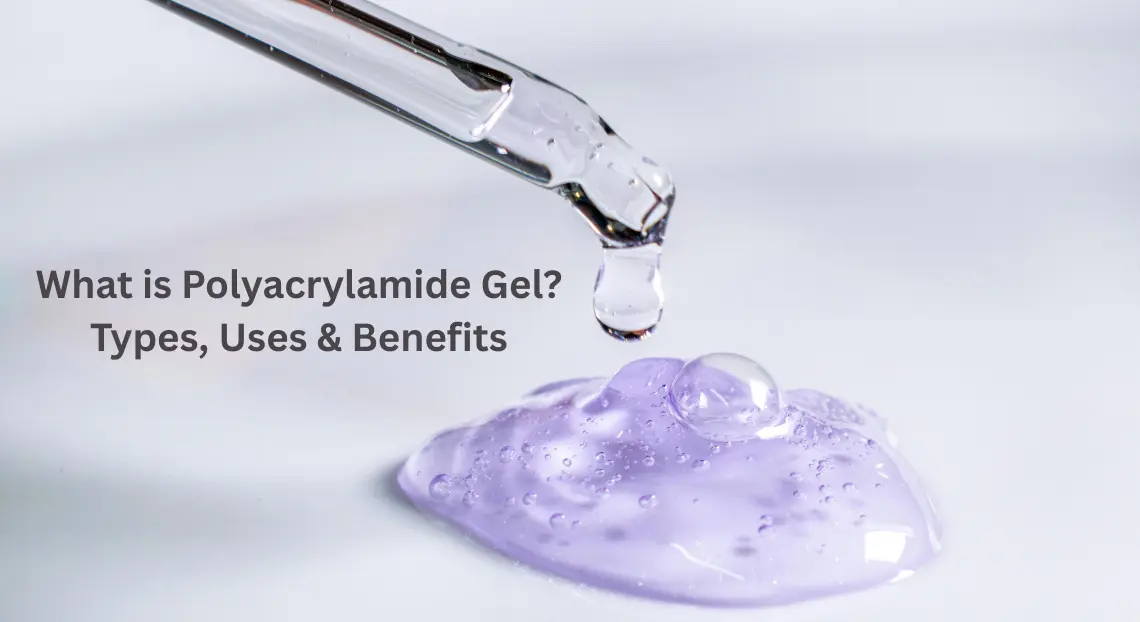
What is Polyacrylamide Gel?
A polyacrylamide gel is a soft, transparent gel made by polymerizing acrylamide with a small amount of a cross-linker (usually bisacrylamide). It forms a fine, sponge-like network that can separate molecules based on size and charge.
In simple terms
Think of it like a very fine sieve. Smaller molecules move through it easily, while bigger ones move slower.
Chemical Composition and Structure of Polyacrylamide Gel
Role of Acrylamide in Gel Formation
Acrylamide is the main building block of polyacrylamide gel. When polymerized, it forms long chains called polymers. These chains create the framework of the gel and determine its water-holding capacity. The concentration of acrylamide directly controls the pore size. Higher acrylamide levels produce smaller pores, which are ideal for separating tiny molecules, while lower concentrations create larger pores for bigger molecules. This ability to adjust pore size makes polyacrylamide gel highly versatile for different laboratory applications.
Function of Bisacrylamide as a Cross-Linker
Bisacrylamide connects the acrylamide chains at multiple points, forming a three-dimensional network. This cross-linking stabilizes the gel structure and gives it strength to hold its shape during electrophoresis. Without bisacrylamide, the gel would be weak, fragile, and unable to maintain uniform pores for effective separation.
Three-Dimensional Gel Network Explained
The combination of acrylamide and bisacrylamide forms a transparent, sponge-like network. This three-dimensional structure holds water and allows molecules to move through based on size and shape. The uniform pores ensure high-resolution separation of proteins, DNA, or RNA. By adjusting the ratio of acrylamide to bisacrylamide, scientists can customize the gel’s porosity to match the specific requirements of their experiments.
How Polyacrylamide Gel Is Formed?
Polymerization Process of Polyacrylamide Gel
Polyacrylamide gel is formed through a chemical reaction called polymerization. In this process, acrylamide molecules link together to form long chains. A small amount of bisacrylamide is added at the same time to connect these chains into a solid network. As the reaction progresses, the liquid solution turns into a soft, jelly‑like gel. The gel sets in the shape of the mold or tray where it is poured. This solid network of polymers with tiny pores is what makes polyacrylamide gel useful for separating molecules.
Initiators and Catalysts Used in Gel Formation
To start the polymerization reaction, specific chemicals called initiators and catalysts are used. The most common initiator is ammonium persulfate (APS). APS breaks down to form free radicals that trigger the polymerization of acrylamide and bisacrylamide. A catalyst such as N,N,N’,N’‑tetramethylethylenediamine (TEMED) helps speed up this reaction. Together, APS and TEMED ensure that the gel forms evenly and within a predictable time. Without these chemicals, the gel would not form properly.
Factors Affecting Gel Formation
Several factors influence how well polyacrylamide gel forms. The ratio of acrylamide to bisacrylamide determines the pore size and strength of the gel. Temperature also affects polymerization; higher temperatures speed up the reaction. The purity of the chemicals and the accuracy of measurements play a role in gel quality. Proper mixing and timing are essential to achieve a uniform gel that performs well in laboratory applications.
Types of Polyacrylamide Gels
Native Polyacrylamide Gel
A native polyacrylamide gel is used when samples need to remain in their natural form. In this type of gel, no harsh chemicals are added to change the structure of proteins or other molecules. Because the molecules keep their original shape and charge, they move through the gel based on both size and native charge. This type of gel is useful when the goal is to study the natural state or activity of a molecule without altering it.
SDS Polyacrylamide Gel
SDS polyacrylamide gel is the most common type used in laboratories for protein analysis. SDS, or sodium dodecyl sulfate, is a detergent that binds to proteins and gives them a uniform negative charge. This removes the effect of the protein’s natural shape and charge, so separation happens only by size. Smaller proteins move faster through the gel, and larger proteins move slower. This makes SDS gels ideal for comparing protein sizes and checking purity.
Gradient Polyacrylamide Gel
Gradient polyacrylamide gel has a range of pore sizes in a single gel. It starts with large pores at the top and gradually changes to smaller pores at the bottom. This design helps separate a wide range of molecule sizes in one run. Gradient gels are useful when the sample contains molecules with very different sizes. They provide smoother separation and clearer results because molecules can be resolved more evenly across the gel.
Pore Size and Gel Concentration
Relationship Between Acrylamide Concentration and Pore Size
The pore size of a polyacrylamide gel is directly controlled by the concentration of acrylamide used during gel preparation. Higher acrylamide concentrations produce smaller pores, while lower concentrations result in larger pores. Smaller pores are suitable for separating tiny molecules like small proteins or short DNA fragments. Larger pores are needed for bigger molecules, allowing them to move through the gel without being blocked. The precise control of pore size is what makes polyacrylamide gels highly versatile for different laboratory applications.
Choosing the Right Gel Percentage
Selecting the correct gel percentage is critical for effective separation. Low-percentage gels, typically between 4% and 8%, are used for large molecules, whereas high-percentage gels, between 10% and 20%, are suitable for smaller molecules. For mixtures with a wide range of molecule sizes, gradient gels can be used to cover both small and large molecules in a single run. Choosing the right gel percentage ensures clear, distinct bands and accurate analysis.
Impact on Separation Efficiency
The concentration of the gel affects how fast molecules move and how well they are separated. If the pores are too large for the sample, small molecules may move too quickly and appear blurred. If the pores are too small, large molecules may get stuck or move unevenly. Proper pore size and gel concentration result in sharp, well-defined bands, making analysis reliable and reproducible.
Principle of Polyacrylamide Gel Electrophoresis
How Separation Works?
Polyacrylamide gel electrophoresis (PAGE) separates molecules based on their size and charge. The gel acts as a sieve, allowing smaller molecules to move faster while larger molecules move slower. In SDS-PAGE, the effect of the natural charge of proteins is removed, so separation depends only on size. This principle ensures that molecules of different sizes can be clearly distinguished.
Role of Electric Field
An electric field is applied across the gel during electrophoresis. One end of the gel is negatively charged, and the other end is positively charged. Negatively charged molecules move toward the positive end, while positively charged molecules move toward the negative end. The electric field provides the force that drives the movement of molecules through the gel pores. The speed of movement depends on the molecule’s size, shape, and charge.
Movement of Molecules Through the Gel
As molecules travel through the gel, the three-dimensional network slows larger molecules more than smaller ones. Smaller molecules pass quickly through the pores, creating distinct bands. Over time, molecules separate into clear patterns based on their size and mobility. These bands can then be visualized using staining techniques. Proper gel concentration, voltage, and running time are essential for achieving sharp, well-defined bands, making analysis accurate and reproducible.
Applications of Polyacrylamide Gel
Protein Separation and Analysis
Polyacrylamide gel is widely used to separate and analyze proteins in research and diagnostics. SDS-PAGE allows scientists to determine the size and purity of proteins. It is commonly used in laboratories to check protein expression, study enzyme activity, and identify protein modifications. The gel provides high resolution, making it possible to distinguish proteins that differ only slightly in size.
DNA and RNA Analysis
Polyacrylamide gels are also used to separate small DNA and RNA fragments. Unlike agarose gels, polyacrylamide gels can separate molecules with very small size differences, making them ideal for genetic studies, mutation detection, and sequencing applications. Researchers use these gels to study short DNA sequences or RNA molecules in a precise and controlled way.
Clinical and Diagnostic Uses
In clinical laboratories, polyacrylamide gel electrophoresis is used to detect and analyze specific proteins in blood or other body fluids. It helps diagnose conditions such as multiple myeloma, hemoglobin disorders, and immune deficiencies. The ability to resolve proteins with high accuracy makes it valuable in medical testing.
Research and Academic Applications
Polyacrylamide gels are essential in molecular biology, biochemistry, and biotechnology research. They are used to study protein-protein interactions, DNA-protein binding, and other molecular mechanisms. Their versatility, high resolution, and reproducibility make them a standard tool for laboratory experiments worldwide.
Advantages of Polyacrylamide Gel
High Resolution Separation
One of the main advantages of polyacrylamide gel is its ability to separate molecules with high precision. The uniform and controllable pore size allows clear distinction between molecules that differ only slightly in size. This makes it ideal for protein analysis, DNA and RNA studies, and other applications where accurate separation is critical.
Adjustable Pore Size
The pore size of polyacrylamide gel can be easily adjusted by changing the concentration of acrylamide and bisacrylamide. This flexibility allows scientists to customize the gel for molecules of different sizes, from very small proteins to larger nucleic acids. Adjustable pore size enhances the versatility of the gel for various laboratory experiments.
Versatility in Applications
Polyacrylamide gel is suitable for a wide range of applications. It can be used in native form to study molecules in their natural state or with SDS to separate molecules strictly by size. Gradient gels can handle samples with a wide size range, making the gel applicable for both research and clinical studies.
Reproducibility and Stability
Polyacrylamide gels provide consistent and reproducible results when prepared correctly. The gel structure is stable under normal laboratory conditions, allowing multiple runs without significant variation. This reliability makes it a preferred tool in research and diagnostic laboratories.
Limitations of Polyacrylamide Gel
Toxicity of Acrylamide
A major limitation of polyacrylamide gel is the toxicity of acrylamide in its unpolymerized form. Acrylamide is a neurotoxin and must be handled carefully during gel preparation. Proper safety measures, such as gloves, masks, and lab ventilation, are necessary to avoid exposure. Once polymerized, the gel is much safer to handle, but caution is still required during disposal.
Limited Use for Large Molecules
Polyacrylamide gels have small pores, which makes them ideal for separating small proteins and nucleic acids. However, they are less effective for very large DNA fragments or macromolecules. Large molecules may move very slowly or get trapped in the gel, making separation inefficient. For such cases, agarose gels or other separation techniques are preferred.
Fragility and Handling Issues
Polyacrylamide gels are soft and fragile once set. They can tear or break easily during handling, staining, or transfer processes. This requires careful handling and proper equipment to avoid damaging the gel and losing the sample.
Preparation Sensitivity
The quality of the gel depends on precise measurement of chemicals and controlled polymerization conditions. Any mistakes in preparation, such as incorrect ratios of acrylamide and bisacrylamide or uneven mixing, can result in poor gel formation, uneven pore size, or distorted results.
Despite these limitations, polyacrylamide gel remains a highly valuable tool for high-resolution molecular separation in laboratories.
Safety and Handling Guidelines for Polyacrylamide Gel
Hazards of Unpolymerized Acrylamide
The main safety concern with polyacrylamide gel comes from unpolymerized acrylamide, which is toxic and can affect the nervous system. Direct contact with skin, inhalation of dust, or accidental ingestion must be avoided. Proper protective measures, including gloves, lab coats, and safety goggles, are essential when preparing the gel. Work should always be done in a well-ventilated area or under a fume hood to reduce exposure.
Safe Preparation Practices
During gel preparation, it is important to measure chemicals accurately and follow the correct procedure for polymerization. Initiators and catalysts, such as ammonium persulfate and TEMED, should be handled carefully as they can also irritate skin or eyes. Avoid splashes and spills, and clean surfaces immediately if any solution comes into contact with them. Using clean and dedicated equipment reduces the risk of contamination and ensures consistent gel quality.
Storage and Disposal Precautions
Once the gel is polymerized, it is safer to handle, but proper disposal is still required. Used gels should be collected and disposed of according to laboratory chemical waste protocols. Store unpolymerized acrylamide in a secure, labeled container away from heat or direct sunlight. Maintaining proper storage and handling practices ensures both safety and reliability of the gel for experiments.
Following these guidelines helps prevent accidents and ensures a safe working environment in the laboratory.
Storage and Stability of Polyacrylamide Gel
Proper Storage Conditions
Polyacrylamide gels should be stored under controlled conditions to maintain their stability and performance. Once the gel is polymerized, it should be kept in a sealed container or wrapped in plastic to prevent drying out. The gel should be stored at low temperatures, typically between 4°C and 8°C, to slow down any degradation and maintain its structure. Avoid exposing the gel to direct sunlight or high temperatures, as this can cause shrinkage or uneven pore formation.
Shelf Life of Prepared Gels
The shelf life of a prepared polyacrylamide gel depends on its concentration and storage conditions. Generally, freshly prepared gels are best used within a few days for optimal performance. Over time, gels may become brittle, develop cracks, or lose uniformity, which can affect the accuracy of separation. For long-term experiments, it is recommended to prepare gels shortly before use.
Factors Affecting Gel Stability
Several factors influence gel stability, including the concentration of acrylamide and bisacrylamide, polymerization quality, and handling. Gels that are not properly polymerized or exposed to rough handling may break or deform. Keeping gels hydrated and handling them carefully ensures consistent results. By following proper storage and handling practices, polyacrylamide gels can remain stable and provide reliable performance for laboratory experiments.
FAQs
1. What is polyacrylamide gel used for?
Polyacrylamide gel is used to separate proteins, DNA, and RNA based on size and charge in laboratory experiments.
2. How does polyacrylamide gel separate molecules?
Molecules move through the gel pores at different speeds. Smaller molecules move faster, and larger molecules move slower, creating separation.
3. What is the difference between SDS-PAGE and native PAGE?
SDS-PAGE separates proteins based on size only, while native PAGE separates molecules based on size and natural charge or shape.
4. How do I choose the right gel concentration?
Choose the concentration based on molecule size. High concentrations are for small molecules, low concentrations for large molecules, and gradient gels for a wide range of sizes.
5. Is polyacrylamide gel safe to handle?
Polyacrylamide gel is safe after polymerization. Unpolymerized acrylamide is toxic and must be handled with gloves, masks, and proper ventilation.
6. Can polyacrylamide gel be stored for long periods?
Polymerized gels can be stored at 4–8°C for a few days. Long storage may cause cracks or pore changes, reducing effectiveness.
7. Why does my gel have uneven or distorted bands?
Uneven bands usually result from poor polymerization, incorrect gel concentration, improper mixing, or uneven sample loading.
8. Can polyacrylamide gel separate very large DNA fragments?
No. It is best for small DNA or RNA fragments. Large fragments are better separated using agarose gels.
Conclusion
Polyacrylamide gel is a versatile and essential tool in molecular biology and biochemistry. Its unique three-dimensional structure with adjustable pore size allows precise separation of proteins, DNA, and RNA. Different types of gels, including native, SDS, and gradient gels, make it suitable for a wide range of laboratory applications, from research to clinical diagnostics. While it offers high resolution, reproducibility, and flexibility, careful handling is necessary due to the toxicity of unpolymerized acrylamide. Proper gel preparation, storage, and handling ensure reliable and consistent results. Overall, polyacrylamide gel remains a critical material for accurate molecular analysis, providing scientists and researchers with the precision needed to study biomolecules effectively.