


What Are Anti-Scalants?
Anti-scalants are chemicals used in water treatment to prevent scale buildup in equipment and pipelines. Scale forms when dissolved minerals in water start to crystallize and stick to surfaces. Over time, these deposits can block pipes, damage membranes, and reduce system efficiency. Anti-scalants help stop this process before it becomes a problem.
Definition Of Anti-Scalants
An anti-scalant is a chemical additive that prevents minerals in water from forming hard deposits on surfaces.
Purpose in Water Treatment
The main purpose of anti-scalants is to control mineral scaling. When water is heated, pressurized, or concentrated, minerals like calcium, magnesium, barium, and silica can come out of solution and form solid deposits. Anti-scalants keep these minerals dispersed in the water so they do not settle on equipment.
What Is Scale in Water Systems?
What Scale Means in Water Treatment?
Scale is a hard layer of mineral deposits that forms on the inner surfaces of pipes, boilers, membranes, and other equipment that handle water. These deposits usually come from minerals naturally present in water, especially calcium and magnesium compounds. Over time, the minerals settle and create a solid layer that sticks tightly to surfaces. Scale is common in industrial water systems, cooling towers, boilers, and reverse osmosis units, where water is heated, pressurized, or reused.
How Dissolved Minerals Turn Into Deposits?
Water normally carries dissolved salts and minerals. When the concentration of these minerals becomes higher than what the water can hold, they start to form tiny crystals. These crystals slowly grow and attach to surfaces such as pipes or heat exchangers. This process is called mineral precipitation. Calcium carbonate is one of the most common materials found in scale, but sulfate salts, silica, and other minerals can also be involved.
Conditions That Increase Scale Formation
Scale forms faster when certain conditions change inside a water system. High temperature, evaporation, pressure, and changes in pH can reduce the ability of water to hold dissolved minerals. When this happens, the minerals come out of the water and settle on equipment surfaces. Hard water with high levels of calcium or magnesium also increases the risk of scale buildup.
Common Types of Scale in Industrial Water Systems
Calcium Carbonate Scale in Water Systems
Calcium carbonate scale is one of the most common types found in industrial equipment. It forms when water that contains calcium and bicarbonate is heated or when the pH becomes higher. Under these conditions the minerals come out of the water and form a hard layer on pipes, boilers, and heat exchangers. This type of scale is often called limescale. It can reduce heat transfer and restrict water flow if it builds up over time.
Calcium Sulfate Scale in Industrial Equipment
Calcium sulfate scale forms when calcium reacts with sulfate ions in water. It usually appears in systems where water becomes concentrated, such as boilers and reverse osmosis units. This type of scale is harder and denser than carbonate scale, which makes it more difficult to remove once it forms. If not controlled, it can reduce system performance and increase maintenance needs.
Barium and Strontium Sulfate Scale
Barium sulfate and strontium sulfate scales are less common but very troublesome in industrial systems. They form when barium or strontium in water reacts with sulfate ions. These compounds have very low solubility, so they easily form solid deposits. Once attached to surfaces, they are difficult to dissolve and can block pipes and membranes.
Silica Scale in Water Treatment Systems
Silica scale forms when water contains high levels of dissolved silica. When temperature, pH, or concentration changes, silica can come out of solution and create very hard deposits. Silica scale is especially difficult to remove because it behaves like glass and does not dissolve easily in common cleaning chemicals.
How Anti-Scalants Prevent Scale Formation?
Threshold Control of Mineral Crystals
Anti-scalants work even at very low doses. They stop minerals in water from forming solid crystals when the water becomes concentrated. Normally, minerals such as calcium carbonate start forming crystals when their level becomes too high. Anti-scalants interfere with this early stage of crystal formation. Because of this, the minerals stay dissolved in the water instead of sticking to pipes, membranes, or heat exchangers. This process is often called threshold control.
Distortion of Crystal Growth
When some crystals still begin to form, anti-scalants change their shape. Instead of forming strong and well-structured crystals, the minerals grow in weak and irregular forms. These distorted crystals cannot attach firmly to equipment surfaces. As a result, they remain loose in the water flow and are carried away by the system instead of building a hard scale layer.
Keeping Particles Dispersed in Water
Anti-scalants also help keep tiny mineral particles separated from each other. Without treatment, these particles combine and grow into larger deposits. Anti-scalants surround the particles and prevent them from sticking together. This keeps the particles suspended in the water so they can move through the system without causing blockages.
Preventing Mineral Precipitation
Changes in temperature, pressure, or pH often cause dissolved minerals to come out of water. Anti-scalants slow down this reaction and reduce the chance of precipitation. By controlling this process, they help protect equipment and maintain smooth system operation.
Types of Anti-Scalant Chemicals Used in Water Treatment
Phosphonate-Based Anti-Scalants
Phosphonate anti-scalants are widely used in industrial water treatment systems. These chemicals contain phosphonic acid groups that help control mineral deposits. They work by reacting with metal ions such as calcium and magnesium and stopping them from forming hard crystals. Because of this property, phosphonate products are effective against common scales like calcium carbonate and calcium sulfate. They are often used in reverse osmosis plants, cooling towers, and boilers where water temperature and mineral concentration are high.
Polymer-Based Anti-Scalants
Polymer anti-scalants are another common option in water treatment. These products are usually made from materials such as polyacrylate or polymaleate. Their main role is to control scale formation and keep particles dispersed in water. They prevent small mineral crystals from joining together and forming large deposits on equipment surfaces. Polymer-based products are especially useful in systems that handle high levels of silica, phosphate, or suspended solids.
Carboxylate-Based Anti-Scalants
Carboxylate anti-scalants are polymers that contain carboxyl functional groups. These chemicals provide strong scale control and good dispersion in water systems. They are commonly used in reverse osmosis plants, boilers, and cooling circuits. Carboxylate polymers help keep insoluble minerals suspended in the water so they do not settle on surfaces or form thick deposits inside equipment.
Blended and Specialty Anti-Scalant Formulations
Many modern anti-scalants are blended formulations. These products combine phosphonates, polymers, or other additives to control different types of scale at the same time. Blended chemicals are designed for complex water conditions and are commonly used in large industrial and desalination systems where multiple minerals may cause scaling.
Key Properties of an Effective Anti-Scalant
Strong Ability to Stop Scale Formation
A good anti-scalant must be able to control scale before it forms on equipment. It should slow down or stop the growth of mineral crystals such as calcium carbonate, calcium sulfate, and silica. When the chemical works properly, minerals remain in the water instead of sticking to surfaces. This helps keep pipes, membranes, and heat exchangers clean and working properly.
Compatibility with Water Chemistry
Water quality is different in every system. Some water contains high calcium, while other sources may contain silica, sulfate, or iron. An effective anti-scalant must work well with the specific chemistry of the water being treated. If the product is not compatible, scale may still form or the treatment may not perform well.
Stable Under Different Temperatures and pH Levels
Industrial water systems often operate under changing conditions. Temperature, pressure, and pH can vary depending on the process. A reliable anti-scalant should remain stable and active under these conditions. This stability allows the chemical to continue controlling mineral deposits without breaking down or losing effectiveness.
Effective Performance at Low Dosage
Another important property is the ability to work at low concentration. Most anti-scalants are designed to control scale with small doses. This reduces chemical consumption, lowers operating costs, and makes the treatment process more efficient for large water systems.
Major Industrial Uses of Anti-Scalants
Use in Reverse Osmosis Water Treatment Systems
Reverse osmosis systems are one of the most common places where anti-scalants are used. During the filtration process, dissolved salts become concentrated on the membrane surface. This can lead to mineral deposits that block the membrane and reduce water flow. Anti-scalants are added to the feed water to stop these deposits from forming and to keep the membrane working efficiently for a longer time.
Role in Desalination Plants
Desalination plants treat seawater or brackish water that contains a high amount of dissolved minerals. These minerals can quickly form scale inside pipes and filtration units. Anti-scalants help control this problem by preventing salt crystals from settling on equipment surfaces. This improves system performance and helps the plant operate continuously without frequent cleaning.
Use in Cooling Towers and Boilers
Cooling towers and boilers operate at high temperatures, which increases the risk of scale formation. Mineral deposits in these systems can reduce heat transfer and lower efficiency. Anti-scalants are used to keep minerals suspended in water and protect internal equipment from buildup. This helps maintain proper heat exchange and stable operation.
Application in Oil, Gas, and Industrial Water Treatment
In oil and gas operations, mineral scale can form inside pipelines, pumps, and injection systems. Anti-scalants help prevent these deposits and keep fluids moving smoothly. They are also widely used in industrial water treatment plants to protect equipment, reduce maintenance, and support reliable system performance.
Anti-Scalants in Reverse Osmosis Systems
Why RO Membranes Are Prone to Scaling?
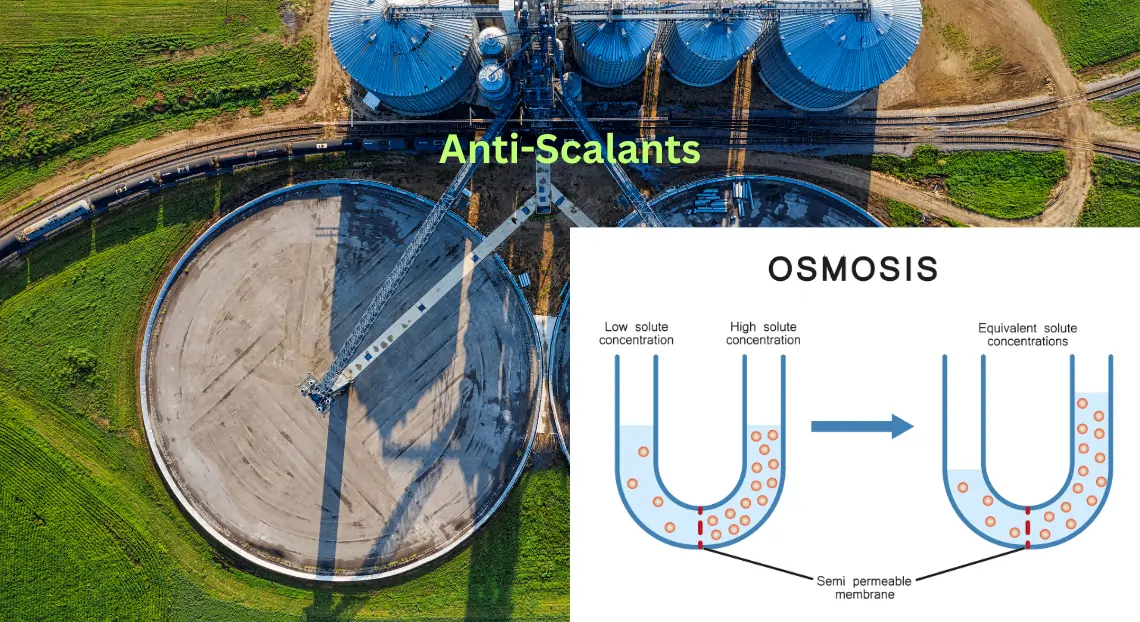
Reverse osmosis systems remove salts and minerals from water by pushing water through a semi-permeable membrane. During this process, the rejected salts become more concentrated on the surface of the membrane. When the concentration becomes too high, minerals such as calcium carbonate, calcium sulfate, barium sulfate, and silica start forming solid deposits. These deposits attach to the membrane surface and block the flow of water. As scale builds up, the system produces less water and requires higher pressure to operate.
Role of Anti-Scalants in Protecting RO Membranes
Anti-scalants are added to the feed water before it enters the RO unit. Their job is to keep minerals dissolved and stop them from forming crystals on the membrane surface. These chemicals interfere with the reactions that normally cause scaling. By doing this, they prevent common mineral deposits such as calcium carbonate, sulfate salts, and silica from attaching to the membrane. This protection allows the membrane to operate under normal conditions without rapid fouling.
Benefits for RO System Performance and Membrane Life
Using anti-scalants helps maintain stable system performance. When scaling is controlled, water flow remains steady and the system does not need frequent cleaning. It also reduces maintenance costs and lowers the chance of membrane replacement. In many plants, anti-scalants help extend membrane life and improve overall efficiency of the RO process.
Benefits of Using Anti-Scalants in Water Systems
Protection of Equipment from Scale Damage
Anti-scalants help protect important equipment used in water systems. When scale forms inside pipes, boilers, membranes, or heat exchangers, it creates a hard layer that blocks water flow and reduces heat transfer. Over time this buildup can damage equipment and lead to costly repairs. By preventing mineral deposits from forming, anti-scalants help keep internal surfaces clean and systems running safely.
Better System Efficiency and Performance
When scale is controlled, water systems can operate as designed. Clean pipes and membranes allow water to flow smoothly and heat transfer to occur properly. This improves the overall efficiency of the process. Equipment does not need to work harder to push water through blocked passages, which helps maintain stable operation.
Lower Maintenance and Less Downtime
Scale buildup often requires frequent cleaning, chemical treatment, or equipment shutdown. These activities take time and can interrupt production. Anti-scalants reduce the amount of scale that forms, which means systems can run longer without stopping for maintenance.
Longer Equipment Service Life and Lower Costs
Keeping equipment free from scale helps extend its service life. Pumps, membranes, heat exchangers, and pipelines last longer when they are not exposed to heavy mineral buildup. This also helps reduce operating costs because companies spend less on repairs, replacements, and energy.
Factors to Consider When Choosing an Anti-Scalant
Understanding the Composition of Feed Water
The first step in selecting the right anti-scalant is to study the water being treated. Water may contain minerals such as calcium, magnesium, sulfate, bicarbonate, or silica. These minerals are the main cause of scale. Their concentration helps determine which type of anti-scalant will work best. Water analysis is often done before selecting a product so the treatment can target the specific scale risk in the system.
System Type and Operating Conditions
Different water systems operate under different temperatures, pressures, and flow conditions. These factors affect how minerals behave and how quickly scale can form. The anti-scalant selected should be able to perform well under the same operating conditions. Systems such as reverse osmosis plants, boilers, and cooling towers may require different formulations to control scaling effectively.
Compatibility with Membranes and Treatment Chemicals
It is important to choose an anti-scalant that is compatible with the materials used in the system. Some membranes or filtration components can be sensitive to certain chemicals. Using an incompatible product may damage the membrane or reduce system performance. Manufacturers usually provide guidelines to help match the right anti-scalant with the equipment and other chemicals used in treatment.
Environmental and Safety Considerations
Environmental impact is another factor to consider. Many industries prefer anti-scalants that have low toxicity and are safer for discharge. Choosing environmentally responsible products helps meet regulations and supports sustainable water treatment practices.
Common Challenges in Controlling Scale in Water Systems
Problems Caused by Incorrect Chemical Dosing
One common issue in scale control is using the wrong amount of anti-scalant. If the dose is too low, minerals can still form deposits on equipment surfaces. If the dose is too high, it may increase operating cost and sometimes affect other parts of the treatment process. Proper dosing usually depends on water quality, mineral concentration, and system design. Regular checks help maintain the correct balance.
Changes in Water Chemistry
Water quality does not always stay the same. Seasonal changes, different water sources, or process changes can alter mineral levels, pH, or temperature. When these conditions change, the risk of scale formation can also increase. If the treatment program is not adjusted, scaling may begin even when anti-scalants are being used.
Lack of System Monitoring
Effective scale control requires regular monitoring of the system. Without proper monitoring, problems such as rising mineral concentration, pressure changes, or early scale formation may go unnoticed. This can reduce the effectiveness of the treatment and lead to buildup inside pipes, membranes, or heat exchangers.
Mixing with Incompatible Treatment Chemicals
Sometimes different water treatment chemicals are used together. If they are not compatible, they can react with each other and reduce performance. In some cases, the reaction may even create deposits instead of preventing them. Careful chemical selection and proper system management help avoid this problem.
Conclusion
Anti-scalants play an important role in keeping water systems clean and efficient. Minerals naturally present in water can form hard deposits inside pipes, membranes, boilers, and heat exchangers. If this buildup is not controlled, it can reduce system performance, increase energy use, and lead to costly maintenance.
By preventing mineral crystals from forming and sticking to surfaces, anti-scalants help maintain smooth operation in many industrial processes. They are widely used in reverse osmosis plants, cooling towers, desalination facilities, boilers, and other water treatment systems where scaling is a common issue.
Choosing the right anti-scalant, applying the correct dose, and monitoring the system regularly are key steps for effective scale control. When used properly, these chemicals help protect equipment, extend service life, and keep operations running reliably.
In simple terms, anti-scalants are a practical solution for managing mineral scaling and improving the overall performance of industrial water systems.
Frequently Asked Questions About Anti-Scalants
1. What is an anti-scalant used for?
An anti-scalant is used to prevent mineral deposits from forming in water systems. It helps protect pipes, membranes, boilers, and heat exchangers from scale buildup.
2. Where are anti-scalants commonly used?
They are widely used in reverse osmosis systems, desalination plants, cooling towers, boilers, and many industrial water treatment processes.
3. What causes scale in water systems?
Scale forms when dissolved minerals such as calcium, magnesium, sulfate, or silica come out of the water and attach to equipment surfaces.
4. Can scale damage equipment?
Yes. Scale can block pipes, reduce heat transfer, increase pressure in the system, and shorten the life of equipment.
5. How are anti-scalants added to a system?
They are usually injected into the feed water through a dosing pump before the water enters the system.
6. Do anti-scalants remove existing scale?
No. Anti-scalants mainly prevent new scale from forming. Existing scale usually needs cleaning or chemical removal.
7. Are anti-scalants safe to use in water treatment systems?
When used correctly and in the recommended dose, they are safe for most industrial water treatment systems.
8. How do operators know the correct dosage?
The correct dosage is based on water analysis, system design, and mineral concentration in the feed water. Proper monitoring helps maintain the right level.