

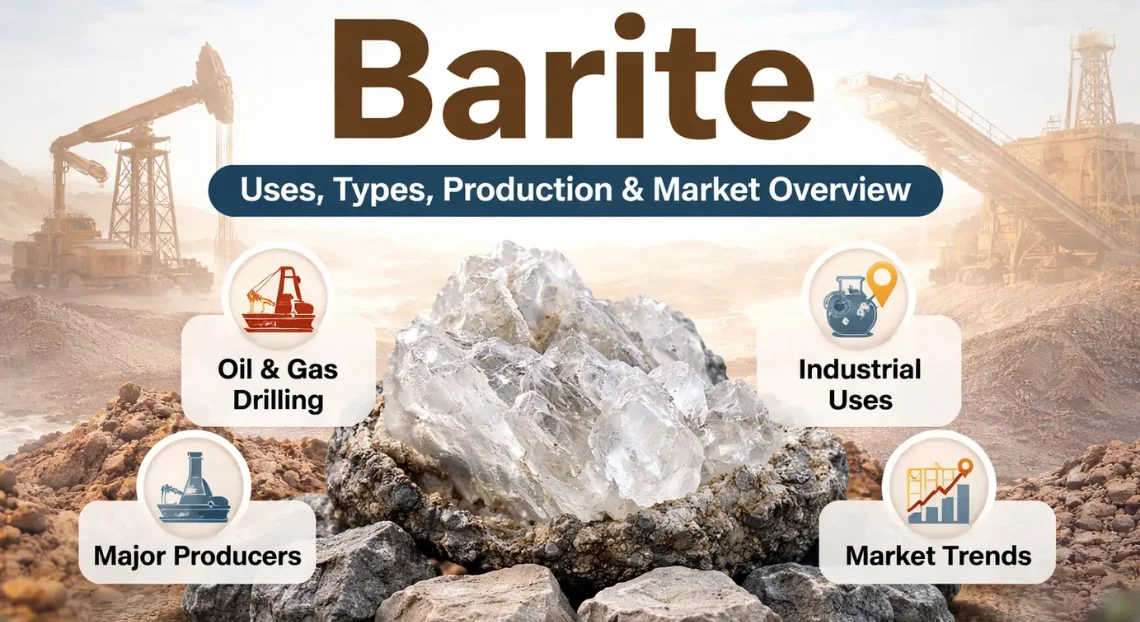
What is Barite?
Barite is a natural mineral that is mainly made from barium sulfate. It is known for its high weight compared to other minerals. Barite is usually found in white, grey, or light-colored form and is taken from the earth through mining.
This mineral does not react easily with water or chemicals, which makes it stable and safe to use in many industries. Because of its heavy nature and chemical stability, barite is widely used in oil and gas drilling, construction, paints, and medical applications. Barite is not a man-made product; it is a naturally occurring industrial mineral.
Why Barite is Important in Industries?
Barite is important in industries because it has a unique combination of properties that very few other minerals can provide together. Its high density makes it useful wherever weight is required without increasing volume. This helps industries control pressure, balance materials, and improve performance in many processes.
Another key reason barite is important is its chemical stability. It does not react easily with water, acids, or other chemicals. This makes it safe to use in harsh industrial environments, including high pressure and high temperature conditions. Industries prefer materials that remain stable over long periods, and barite meets this need well.
Barite is also valued because it is non-toxic and safe to handle. Unlike many heavy minerals, it does not release harmful chemicals during normal use. This allows industries to use it in medical, construction, and manufacturing applications without major health risks.
From a production point of view, barite is important because it is cost-effective and widely available. It can be mined, processed, and used at a reasonable cost, making it suitable for large-scale industrial use.
Because barite combines weight, safety, stability, and affordability, it has become an essential industrial mineral that supports many critical industries worldwide.
One-line Chemical Composition (BaSO₄)
Barite is chemically known as barium sulfate, and its chemical formula is BaSO₄.
This one-line composition means barite contains barium, sulfur, and oxygen in a fixed and stable form. The barium is tightly bonded with the sulfate group, which makes the mineral chemically inert and safe to use. Because of this strong bond, barite does not dissolve in water and does not react easily with other substances.
The presence of barium in this form gives barite its high density, while the sulfate structure keeps it stable under heat, pressure, and chemical exposure. This simple chemical makeup is the reason barite can be used in demanding industrial environments without breaking down or causing harmful reactions.
In short, the chemical formula BaSO₄ explains why barite is heavy, stable, and non-reactive, making it suitable for industrial, medical, and construction-related applications.
What is Barite Made Of?
Chemical Composition
Barite is made of barium sulfate, written as BaSO₄. It contains three main elements: barium, sulfur, and oxygen. These elements are strongly bonded together, which makes barite very stable. It does not dissolve in water and does not react easily with most chemicals. This stable composition allows barite to be used safely in different industrial conditions, including high pressure and high temperature environments.
Physical Properties (Weight, Color, Hardness)
One of the most noticeable properties of barite is its high weight. It is much heavier than common minerals like quartz or limestone. This heavy nature makes barite easy to identify and useful in applications where weight is required.
Barite is usually found in white, grey, yellow, or light brown colors. In pure form, it is white, but impurities in the earth can change its color. The surface of barite crystals can look glassy or dull.
In terms of hardness, barite is a soft to medium-hard mineral. On the Mohs hardness scale, it is around 3 to 3.5, which means it can be scratched with a knife. This softness makes it easier to crush and grind during processing.
Why Barite is a “Heavy” Mineral
Barite is called a heavy mineral because of its high density, mainly due to the presence of barium. Barium is a naturally heavy element, and when combined with sulfate, it forms a dense mineral. This high density is the main reason barite is valued in industrial use.
Is Barite a Chemical, Commodity, or Specialty Material?
Natural Mineral vs Processed Material
Barite is a natural mineral that is found in the earth and mined from underground or open-pit mines. In its natural form, barite occurs as solid rock or crystal deposits. This raw barite is not ready for direct use. It must be processed through crushing, washing, and grinding to meet industrial requirements.
Even after processing, barite does not change its chemical nature. It remains barium sulfate. Processing only improves its purity, particle size, and quality. Because of this, barite is not considered a manufactured chemical. It is a naturally occurring mineral that is prepared for industrial use.
Why Barite is Classified as a Mineral Commodity
Barite is classified as a mineral commodity because it is mined in large quantities and traded globally as a raw material. Its value depends on grade, purity, and density, not on branding or complex chemical formulation.
Industries buy barite based on standard specifications, especially density levels required for drilling and industrial use. Prices are influenced by mining cost, demand, supply, and global energy activity. These are typical features of commodity materials.
Barite is also used across many industries, not limited to one special or niche application. This wide industrial demand further supports its classification as a mineral commodity rather than a specialty product.
Difference Between Raw Barite and Processed Barite
Raw barite is the material that comes directly from mining. It contains impurities such as clay, sand, or other minerals. In this form, it is not suitable for industrial use.
Processed barite is cleaned, crushed, and ground to meet specific industry standards. Some industries require high-purity barite with controlled particle size, while others use lower-grade material.
In simple terms, raw barite is mined, and processed barite is market-ready, but both are still the same natural mineral, not a specialty chemical.
Types of Barite (Based on Use & Grade)
Drilling-grade Barite
Drilling-grade barite is the most commonly used type. It is mainly used in oil and gas drilling operations. This grade has high density and controlled purity so it can add sufficient weight to drilling fluids. It must meet strict industry standards, especially for density and particle size, to perform safely under high pressure conditions. Small impurities are allowed, but density is the key requirement.
Chemical-grade Barite
Chemical-grade barite is used to make barium-based chemicals. This grade requires higher purity compared to drilling-grade barite. Impurities like iron, silica, and other minerals are kept very low. Because of its cleaner composition, it is suitable for chemical processing where consistency and chemical stability are important.
Industrial / Filler-grade Barite
Industrial or filler-grade barite is used in paints, coatings, rubber, plastics, and construction materials. This grade focuses more on particle size and whiteness rather than very high density. It helps improve product thickness, durability, and finish. Filler-grade barite is cost-effective and widely used in large-volume manufacturing.
Medical-grade Barite
Medical-grade barite is the highest purity form. It is mainly used in medical imaging and radiation shielding. This grade must be extremely clean and safe, with strict quality control. It is often processed into fine powder and used in hospitals and diagnostic centers.
How Purity and Density Affect Usage?
The purity and density of barite decide where it can be used. High-density barite is required for drilling, while high-purity barite is needed for chemical and medical use. Lower-grade barite works well as fillers. Each grade is prepared to match the needs of a specific industry.
Major Uses of Barite
Oil & Gas Drilling (Explained Simply)
Barite is mainly used in oil and gas drilling. It is added to drilling fluid to increase its weight. This heavy fluid helps control underground pressure while drilling deep wells. It prevents sudden release of oil or gas and keeps the drilling process safe and stable.
Paints & Coatings
In the paint industry, barite is used as a filler material. It improves paint thickness, smoothness, and durability. Barite also helps paints resist moisture and chemicals. Because it is white and stable, it does not affect color quality and helps reduce production cost.
Construction & Cement
Barite is used in cement and concrete to increase weight and strength. It is commonly used in buildings that require radiation protection, such as hospitals, laboratories, and nuclear facilities. Barite-based concrete helps block harmful radiation and improves structural stability.
Rubber & Plastics
In rubber and plastic products, barite improves strength, weight, and durability. It helps products maintain shape and resist wear. Barite also improves surface finish and reduces manufacturing cost by replacing expensive raw materials.
Medical & Radiation Shielding
Barite is used in the medical field for radiation shielding. It helps block X-rays and gamma rays. In medical imaging, barite-based materials help doctors view internal organs clearly and safely. Its non-toxic nature makes it suitable for medical use.
Chemical Manufacturing
Barite is used as a raw material in the chemical industry to produce barium-based compounds. Its stable composition makes it reliable for chemical processing. These chemicals are later used in electronics, glass, and other industrial applications.
Why Barite is So Important in Oil & Gas Drilling?
Role in Drilling Mud
In oil and gas drilling, a special fluid called drilling mud is used. Barite is added to this mud to increase its weight. The heavy mud flows down the drilling pipe and comes back up, carrying rock cuttings with it. Barite helps keep the mud thick and heavy enough to support the drilling process. Without barite, the drilling fluid would be too light and unstable for deep drilling operations.
How Barite Controls Pressure
As drilling goes deeper, underground pressure becomes very high. If this pressure is not controlled, oil or gas can suddenly escape, causing serious accidents. Barite helps control this pressure by increasing the density of the drilling mud. The heavy mud creates a balancing force that keeps underground fluids under control. This pressure balance protects workers, equipment, and the drilling well from damage. Barite allows drilling to continue safely even at great depths.
Why No Easy Replacement Exists in Drilling
Barite has a rare combination of properties that makes it difficult to replace. It is very heavy, chemically stable, and safe to handle. Many other heavy materials either react with chemicals, damage equipment, or cost more. Barite also mixes well with drilling fluids and does not settle quickly, which is important for smooth drilling.
Some alternative materials exist, but they are used only in limited cases. Most are expensive or cause technical problems. Because of this, barite remains the most reliable and widely accepted material for drilling mud.
For these reasons, barite plays a critical role in oil and gas drilling and is considered an essential industrial mineral in the energy sector.
Barite Mining & Production Process
Barite is mined and processed before it can be used in industries. The process includes mining, cleaning, grinding, grading, and quality checks to make sure the final product meets industry needs.
Mining Methods (Open Pit / Underground)
Barite is found in the earth in large rock deposits. There are two main ways to mine it:
-
- Open pit mining: This method is used when barite is near the surface. Heavy machines remove the top soil and rock to reach the barite. This is simpler and less costly.
- Underground mining: When barite is deeper in the ground, tunnels are dug to reach the ore. Miners then remove the barite rock. This method is used when the deposit is too deep for open pit mining.
Both methods aim to bring barite rock to the surface for further processing.
Crushing and Washing
Once the barite rock is mined, it is moved to a processing plant. The first step is crushing. Large rocks are broken into smaller pieces with crushers. The goal is to make the pieces easy to wash and grind.
After crushing, the barite is washed with water to remove dirt, soil, and other unwanted materials. Washing helps increase the purity of the barite before it is ground into powder.
Grinding and Grading
After washing, the cleaner barite pieces go to a grinding mill. Here, machines crush the barite into fine powder. The size of the powder depends on the industry it will serve. For example, drilling-grade barite needs larger particles than medical-grade barite.
Next, the ground barite is put through grading screens. These screens separate particles based on size. Each size group is collected and stored separately. This step ensures that barite meets the correct density and particle size standards.
Quality Control
Before barite is packed and shipped, it goes through quality control tests. Experts check:
-
- Density
-
- Purity
-
- Particle size
- Moisture level
Only barite that meets industry standards is approved for use. Quality control makes sure that the barite performs well, especially in demanding applications like drilling and medical use.
This complete mining and production process ensures that barite is clean, strong, and ready to be used in various industries.
Major Barite Producing Countries
Barite is mined in many countries, but a few nations lead the world in production and supply. These countries play a key role in meeting industrial demand, especially for oil and gas drilling and other uses.
India (Andhra Pradesh)
India is one of the top barite producers in the world, second only to China in recent years. Most of India’s barite comes from Andhra Pradesh, particularly the Mangampet mine, which is one of the largest barite mines globally. This region supplies a major share of the country’s production and meets both domestic and export demand.
Indian barite is valued for its high specific gravity and good purity, making it suitable for oil drilling, industrial fillers, and chemical production. Andhra Pradesh also has several smaller barite deposits in other districts, ensuring a continuous supply. Local industries benefit from proximity to mines, reducing transportation costs and supporting India’s domestic drilling and chemical sectors.
China
China is the largest producer of barite globally, accounting for a significant portion of world supply. The country has extensive mining operations and well-established processing facilities, allowing it to produce barite for both domestic consumption and exports.
Chinese barite comes in various grades, including drilling-grade, chemical-grade, and filler-grade. The large-scale mining infrastructure and technological investment allow China to maintain consistent production even when global demand fluctuates. Chinese barite is exported to regions like Southeast Asia, Europe, and the Middle East, supporting international drilling and industrial needs.
USA
The United States is an important barite producer, though its output is smaller compared to China and India. U.S. production primarily serves domestic oil and gas drilling operations and industrial applications. States like Nevada, Georgia, and Tennessee have notable barite deposits.
Although U.S. production is limited, the quality of barite mined domestically is high, especially for drilling mud applications. The country also imports barite to supplement supply when demand rises. U.S. industries rely on both local and imported barite to maintain operations, especially during periods of high drilling activity.
Morocco
Morocco produces high-quality barite and ranks among the top global suppliers. Moroccan barite deposits are concentrated in regions such as Nador and other northern areas. These deposits provide barite that is used both locally and exported to industrial markets abroad.
The Moroccan barite is especially valued for its consistency in density and purity, making it suitable for drilling and chemical industries. Morocco’s mining sector has also invested in improving extraction and processing techniques, ensuring a reliable supply of barite to international buyers.
Brief Global Supply Overview
Globally, barite production is concentrated in a few key countries, with China, India, Morocco, and the USA supplying most of the market. Other countries like Kazakhstan, Iran, Mexico, and Pakistan contribute smaller amounts, mainly for regional industrial use.
Global supply depends on mining activity, industrial demand, and oil and gas exploration trends. The consistent output from major producers ensures that industries worldwide have access to barite for drilling, construction, chemicals, and medical applications. Any disruption in supply from these top producers can significantly impact global prices and availability.
Alternatives to Barite
Even though barite is widely used, there are a few alternative materials that can replace it in some applications. However, these alternatives have limitations and cannot fully replace barite in all situations.
Hematite
Hematite is a type of iron oxide mineral (Fe₂O₃) with a higher density than barite. Because of this, it can increase the weight of drilling mud with smaller amounts compared to barite. Hematite also helps reduce the total solids in drilling fluid, which can improve drilling performance.
However, hematite has drawbacks. It is more abrasive than barite and can wear down drilling equipment faster. It may also cause issues with the drilling fluid’s behavior if not properly processed. For these reasons, hematite is used only in specific cases where its benefits outweigh the problems, such as in high-density mud systems.
Ilmenite
Ilmenite is a heavy mineral made of iron and titanium (FeTiO₃). It has high density and can be used to raise drilling fluid weight. Ilmenite can be even denser than barite, making it useful for deep or high-pressure wells.
Like hematite, ilmenite also has disadvantages. It is abrasive and can wear down pumps and other drilling tools. To reduce this, ilmenite is ground into very fine particles, but this adds to the processing cost. Because of its cost and equipment wear, ilmenite is used only in special drilling situations.
Calcium Carbonate
Calcium carbonate (CaCO₃) is another alternative, especially when high density is not needed. It has lower density compared to barite, so it cannot replace barite for deep drilling mud weight. However, calcium carbonate is acid-soluble, which means it can be removed easily with acid during well completion.
Calcium carbonate is often used in shallow drilling or as a bridging material where barite’s heavy weight is not required. Because it dissolves in acid, it can help clean the well faster after drilling.
Why Alternatives Are Limited
Even though substitutes like hematite, ilmenite, and calcium carbonate exist, none can fully replace barite across all applications. The main reasons are:
-
- Barite has the ideal balance of density and low abrasive nature that most drilling applications require.
-
- Alternatives often cost more or require extra processing, which can raise overall drilling costs.
- Only barite meets industry standards (especially API specifications for drilling mud) consistently in most regions.
For these reasons, barite remains the primary material used in drilling mud and other heavy-mineral applications worldwide.
Environmental & Safety Aspects of Barite
Is Barite Toxic or Safe?
Barite itself, which is mainly barium sulfate (BaSO₄), is largely non‑toxic. It is insoluble in water and stable, so most of the time it does not enter the body or react with other substances. Because of this, barite is considered safe for many industrial and medical uses.
However, barite ore can sometimes contain tiny amounts of other minerals, including heavy metals like lead or cadmium. If these minerals are released during mining or processing, they can be harmful to health and the environment. Also, inhaling very fine barite dust over a long time may irritate the lungs. Wearing proper protective gear can prevent breathing problems at work sites.
Environmental Impact of Mining
Mining barite, like other minerals, changes the natural landscape. When land is cleared for mining, vegetation and soil are removed, which can lead to habitat loss, soil erosion, and disruption of local ecosystems. Open‑pit mining particularly changes land shape and drainage patterns.
Water quality is another concern. Mining and ore processing can release sediments and small particles into nearby rivers and ponds, which may make water cloudy and affect aquatic life. In some cases, mining sites expose other metals with barite that can contaminate water and soil over time, especially if waste is not handled properly.
Dust and noise from blasting and machinery are also part of the environmental impact. Without proper controls, dust can spread into nearby villages and farmland, causing air quality issues.
Modern mining tries to manage these effects by using water treatment systems, dust controls, and land reclamation methods to restore mined areas once extraction ends.
Safety Handling During Processing
During barite processing, workers may be exposed to dust and heavy equipment risks. It is important to wear masks, gloves, and protective clothing to reduce inhalation of dust and prevent skin contact with contaminants.
Workplaces should also have good ventilation and safety training so that workers understand how to handle materials safely and what to do in emergencies. Poor safety practices can increase the chance of accidents or long‑term health issues.
In summary: Barite is mostly safe but mining and processing can affect the environment and health if not managed well. Responsible practices and safety measures help reduce risks and protect people and nature.
Barite Market Overview
The global barite market is driven by strong demand from key industries, especially oil and gas drilling, where barite’s weight‑control properties are essential. Barite is also used in paints, plastics, construction, chemicals, and medical applications, which together support steady market growth. According to industry forecasts, the barite market is expected to grow moderately in the coming years as global industrial activity and energy exploration continue to expand.
Global Demand Drivers
The main driver of barite demand is the energy sector, particularly oil and gas drilling. Barite is the preferred mineral for weighting drilling fluids, especially in deepwater and shale wells, where pressure control and well stability are critical. Expansion in global drilling projects, both onshore and offshore, keeps barite demand high, making up around 70 % or more of total consumption.
Beyond energy, growing industrial activities also push demand. Barite is used as a filler in paints, coatings, rubber, plastics, and industrial construction materials. As manufacturing and construction output rise in emerging markets, demand for barite in these sectors continues to grow. Additionally, the medical and healthcare industry uses high‑purity barite for radiation shielding and imaging applications, supporting niche demand increases.
Oil & Gas Impact on Barite Demand
The link between oil and gas activity and barite demand is strong because drilling operations rely on barite for drilling fluid weight. When more wells are drilled or when deep and complex wells are planned, barite use rises. For instance, regions with high drilling activity such as North America and the Middle East consume large volumes of drilling‑grade barite. Even small changes in oil prices or drilling investments can directly affect barite demand, making the market sensitive to oil and gas sector trends.
Price Depends on Grade & Purity
Barite prices vary based on the grade and purity of the mineral. High‑purity barite with consistent density is needed for strict industrial uses like drilling and medical applications. These grades usually command higher prices because they require more processing and quality control. Lower‑grade barite used as fillers in paints or plastics is cheaper because it does not need strict specifications. Overall, market prices are influenced by supply‑demand balance, transportation costs, purity levels, and global energy activity, which can cause price changes over time.
In short, the barite market remains tied to global industrial growth, energy exploration, and the quality of barite needed for specific uses. Continued demand from drilling, manufacturing, and medical sectors supports a stable outlook for the barite market worldwide.
Barite vs Similar Minerals (Quick Comparison)
In industry, barite is often compared with other minerals like bentonite and calcium carbonate because these materials are used in drilling fluids and other industrial products. Although they may look similar, their properties and uses are different.
Barite vs Bentonite
Barite is a heavy mineral made of barium sulfate (BaSO₄), known for its high density and stability. It is mainly used to increase the weight of drilling mud in oil and gas drilling so that underground pressure is controlled and boreholes remain stable. Barite does not swell and is chemically inert under most conditions.
Bentonite, on the other hand, is a type of clay that absorbs water and swells. It is not used for weight but for viscosity and sealing in drilling fluids and other applications. Bentonite makes drilling mud thicker, helps carry rock cuttings up the well, and seals borehole walls to prevent collapse. It also has uses in construction, foundry sands, and sealing ponds because of its high water absorption and gel‑forming ability.
The key difference is that barite adds weight to drilling fluid, while bentonite changes fluid consistency and seals formations.
Barite vs Calcium Carbonate
Barite and calcium carbonate (CaCO₃) can both be used as weighting materials in drilling fluids, but calcium carbonate is lighter than barite and provides less mud weight. Calcium carbonate is easier to dissolve with acid, which can help clean the well after drilling is finished.
Calcium carbonate is a very common and inexpensive mineral used as a filler in paints, plastics, paper, and construction materials. It improves product strength, brightness, and workability, and is also used in cement and as a soil conditioner. Its role as a drilling additive is more about filter cake control and bridging, not heavy weighting like barite.
Key Differences in Use
-
- Weight: Barite has much higher density than bentonite and calcium carbonate, making it the best choice where high mud weight is essential.
-
- Function in Drilling Fluids: Barite adds weight. Bentonite improves viscosity and sealing. Calcium carbonate helps with filtering and clean‑up but provides lower weight.
- Industrial Roles: Barite is mainly used in oil drilling and heavy industrial uses. Bentonite excels in clay applications like sealing and binding. Calcium carbonate is used widely as filler and construction material.
In simple terms, barite’s unique high density and chemical stability make it unmatched for heavy weighting, while bentonite and calcium carbonate serve different supporting roles in drilling and manufacturing.
Conclusion
Barite is a naturally occurring, heavy mineral with the chemical formula BaSO₄. Its unique combination of high density, chemical stability, and non-toxicity makes it an essential material for many industries, especially oil and gas drilling, construction, chemicals, medical applications, and manufacturing.
Its importance in drilling cannot be overstated, as barite is the primary mineral used to control underground pressure and maintain well stability. While alternatives like hematite, ilmenite, and calcium carbonate exist, they cannot fully replace barite due to its ideal balance of weight, stability, and cost-effectiveness.
Globally, countries like China, India, the USA, and Morocco dominate barite production, supplying the majority of industrial demand. The market is influenced by oil and gas activity, industrial growth, and barite grades, with high-purity barite commanding higher prices.
Barite is generally safe to handle, but responsible mining and processing practices are essential to minimize environmental impact and ensure worker safety. With steady demand in energy, infrastructure, and industrial sectors, barite continues to be a critical mineral commodity worldwide.
In short, barite remains irreplaceable in heavy-duty industrial applications, and its stable supply is vital for the safe and efficient functioning of several key industries.
Frequently asked question about Barite
1. What is barite?
Answer: Barite is a natural mineral made of barium sulfate (BaSO₄). It is heavy, stable, and widely used in industries.
2. What is barite used for?
Answer: Barite is mainly used in oil and gas drilling, paints, plastics, construction, chemicals, and medical radiation shielding.
3. Why is barite important in drilling?
Answer: Barite adds weight to drilling mud, controls underground pressure, and keeps wells safe and stable during drilling.
4. Is barite safe or toxic?
Answer: Barite is mostly non-toxic and safe to handle. Long-term inhalation of dust should be avoided with proper safety gear.
5. Where is barite produced?
Answer: Major producers are China, India (Andhra Pradesh), the USA, and Morocco, with other smaller producers around the world.
6. What are the types of barite?
Answer: Types include drilling-grade, chemical-grade, industrial/filler-grade, and medical-grade, each made for specific uses.
7. Can barite be replaced by other minerals?
Answer: Alternatives like hematite, ilmenite, and calcium carbonate exist, but none match barite’s ideal weight, stability, and cost-effectiveness for drilling.
8. How is barite mined?
Answer: Barite is mined using open-pit or underground methods, then crushed, washed, ground, and graded for industrial use.
9. What factors affect barite prices?
Answer: Price depends on grade, purity, particle size, demand from drilling, and industrial use. Higher-purity barite costs more.
10. Is barite used in medicine?
Answer: Yes, medical-grade barite is used for X-ray imaging and radiation shielding because it is heavy, stable, and safe.